
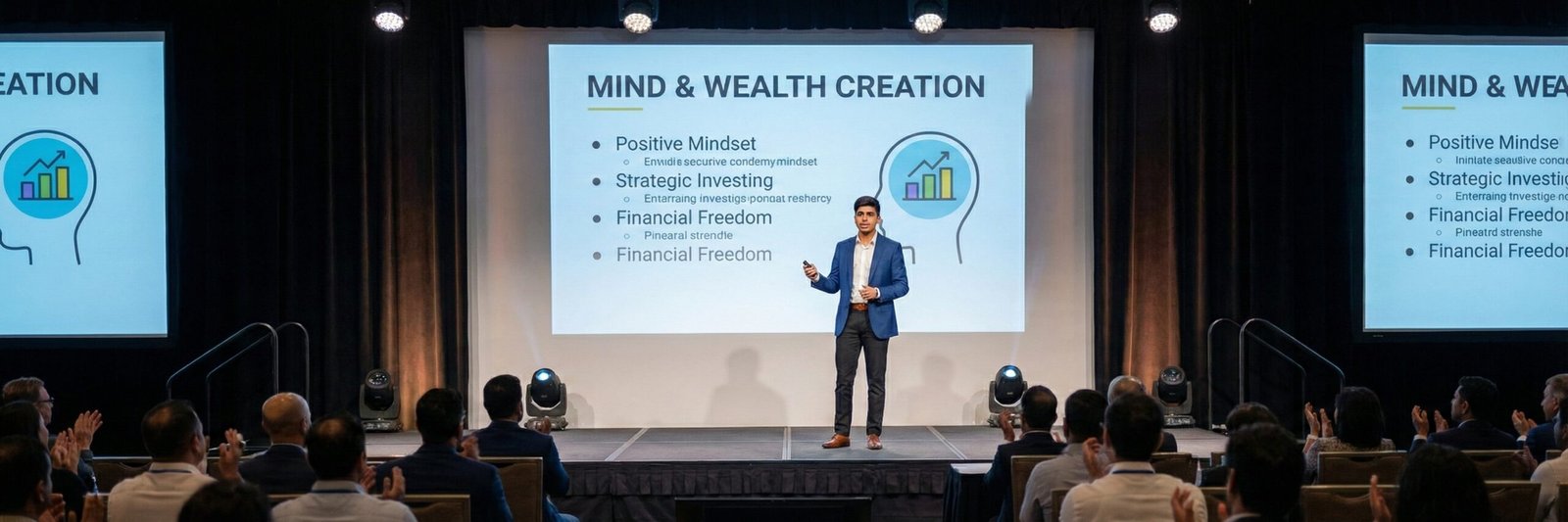

Have you ever wondered why some people seem to move easily through life’s problems while others fall apart at the first sign of a struggle? We often think that successful people are just “born with it.” We look at a smart CEO, a star athlete, or a great musician and think they have a magic gene that the rest of us lack. We assume that their confidence comes from a history of perfect wins. But research into human psychology suggests that the difference between a great life and a stuck one isn’t about raw skill. It proves that Talent is Overrated.
It is actually about your Mindset. Specifically, it comes down to a simple belief you hold about yourself: Are your skills carved in stone, or can they be grown? In this article, we will explore the two specific mindsets that control your power, why “easy perfection” is a dangerous lie, and how you can rewire your brain to turn failure into your best tool.
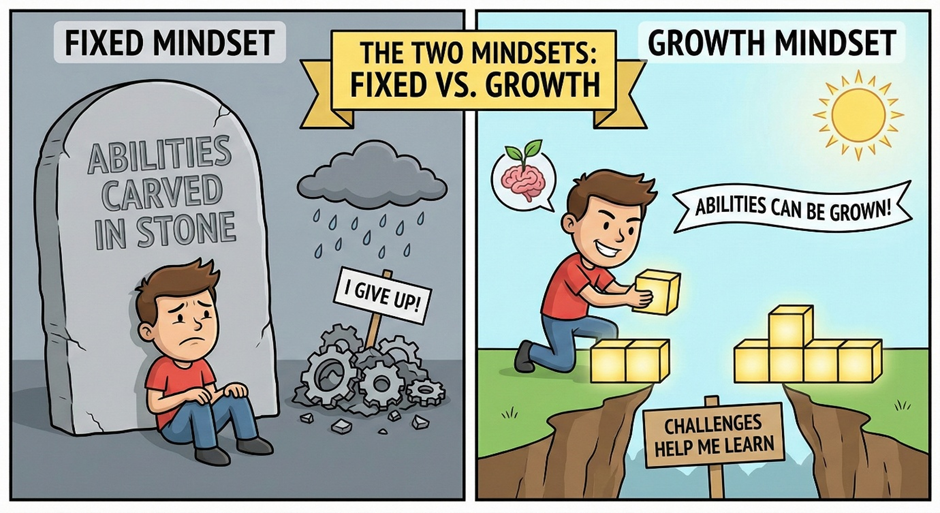
The Two Worlds: Fixed vs. Growth
According to decades of research, people generally fall into one of two mental groups. These groups act like computer operating systems for your life.
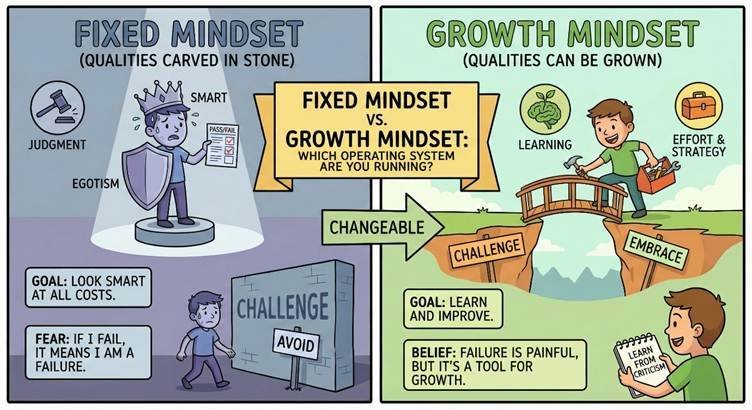
1. The Fixed Mindset In this world, you believe your qualities cannot change. You are either smart or you aren’t. You are artistic or you aren’t. You are a leader or a follower. Because you believe these traits are fixed, you feel a strong, constant need to prove them. Every situation—a job interview, a first date, a hard project—becomes a court case where you are being judged.
- The Goal: Look smart at all costs.
- The Fear: If I fail, it means I am a failure.
- The Reaction: Avoid challenges, hide mistakes, and ignore advice.
2. The Growth Mindset In this world, you believe that your basic qualities are just a starting point. You believe that brains, talent, and personality can be built through hard work, good plans, and help from others. You don’t believe everyone is the same, but you believe that a person’s true potential is unknown.
- The Goal: Learn and improve.
- The Belief: Failure is painful, but it is a tool for growth.
- The Reaction: Embrace challenges, keep going through hard times, and learn from feedback.
The Tale of Two Employees: A Modern Example
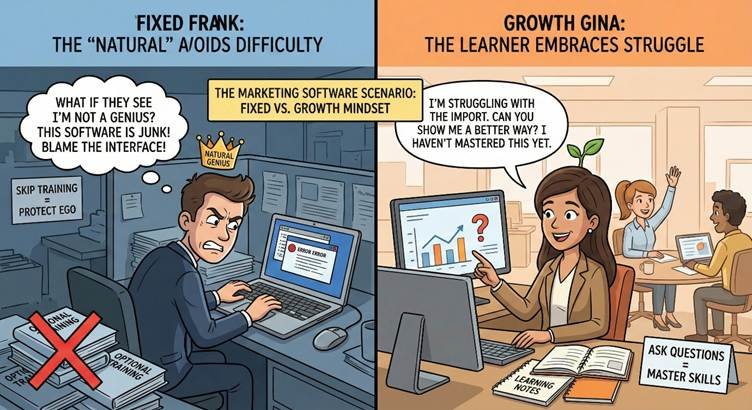
To understand how this plays out in real life, let’s leave the books behind and look at a real story. Imagine a marketing team is learning a hard new computer program. It is difficult to learn and easy to mess up.
Meet “Fixed” Frank: Frank has always been praised for being a “natural” at marketing. When he sees the new software, he feels scared. “What if I can’t figure this out?” he thinks. “People will realize I am not actually a genius.” Frank skips the extra training classes because he doesn’t want to look like a beginner. When he struggles with the software later, he blames the screen: “This program is junk! It is made poorly!” He protects his feelings by refusing to face the difficulty. He stops learning to keep his image perfect.
Meet “Growth” Gina: Gina finds the software just as confusing as Frank does. She makes a mistake on her first report and the numbers come out wrong. But Gina doesn’t think, “I am stupid.” She thinks, “I haven’t mastered this yet.” She raises her hand in the meeting. “I am struggling with this part. Can anyone show me a better way to do it?” Gina isn’t worried about looking like a beginner; she is worried about staying one. By the end of the month, Gina has mastered the tool. Frank is still making excuses.
The “Effort” Paradox: Why We Fear Trying
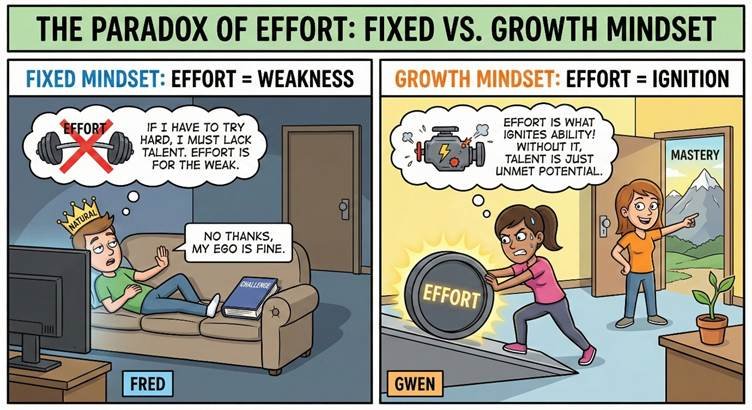
One of the most dangerous side effects of the Fixed Mindset is how it views work. In a world that loves the “natural born genius,” we have been taught that if you have to try hard, you must not be very good. We see the athlete who makes it look easy, or the student who gets an A+ without studying, and we want to be them. This creates a scary logic for people with a Fixed Mindset: “If I have to work hard at this, I must lack talent. Therefore, effort is for the weak.”
The Risk of Trying
Psychological studies have shown that many “gifted” people stop taking risks as they get older. Why? Because effort takes away their excuses. If you don’t study for a test and you fail, you can say, “Well, I didn’t even open the book.” Your ego stays safe. You can tell yourself (and others) that you could have done perfectly. But if you give 100% effort—if you study all week, hire a tutor, and really try—and then you fail? That is the Fixed Mindset’s worst nightmare. It means you simply weren’t good enough. However, the Growth Mindset flips this script. It recognizes that effort is what creates ability. Without effort, Talent is Overrated and nothing more than unused potential.
How Mindsets Redefine Failure
Failure hurts everyone. Nobody enjoys losing a client, getting a “no” letter, or failing a test. But the way we process that pain is very different depending on our mindset.
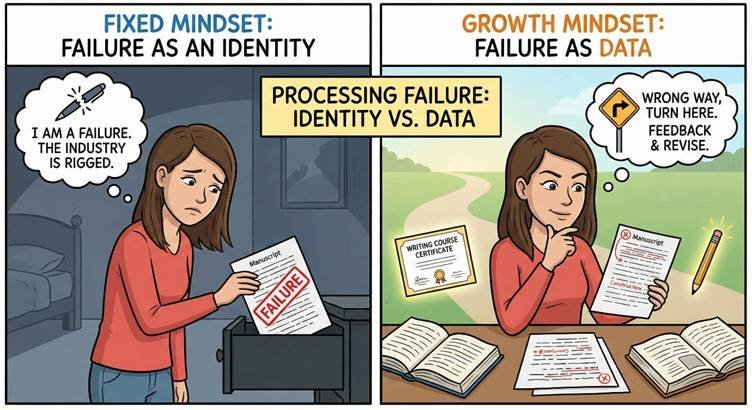
Failure as an Identity vs. Failure as Data For the Fixed Mindset, failure is a label. It changes from an action (“I failed the test”) to a noun (“I am a failure”). This is why one bad review or one “no” can send someone into sadness or make them stop moving. They feel their permanent “score” has been shown. For the Growth Mindset, failure is simply information. It’s a road sign saying, “Wrong way, turn here.”
A Story of Resilience: Consider the story of a young, hopeful writer named “Sarah.” She spent two years writing a book, pouring her heart into it. She sent it to five publishers. All five said no.
- If Sarah had a Fixed Mindset: She would hide the book in a drawer, convinced she is a terrible writer. She might say, “The book business is unfair,” or “I guess I just don’t have the gift.” She stops writing to avoid more pain.
- If Sarah has a Growth Mindset: She is sad, yes. But she asks for advice. She realizes the “no” is about this specific draft, not her worth as a human being. She takes a writing class, fixes the book, and tries again.
The Science of the Brain: It’s Never Too Late
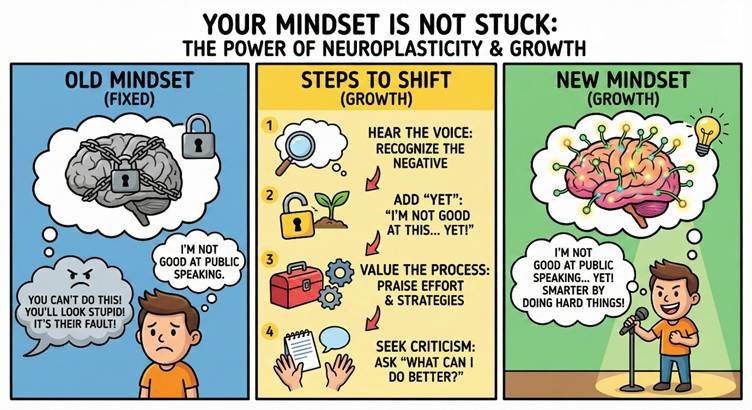
Here is the best news: You are not stuck with your current mindset. Science has proven that the brain is “plastic.” It continues to form new connections and change throughout your entire life. When you learn new things and push through difficulty, your brain actually grows stronger connections. You literally become smarter by doing things that are hard.
Steps to Shift into a Growth Mindset
Hear the Voice: Learn to hear the Fixed Mindset voice in your head. It’s the voice that says, “You can’t do this,” “You’ll look stupid,” or “It’s not your fault, it’s their fault.”
Add the Word “Yet”: When you think, “I’m not good at public speaking,” force yourself to add one word: “I’m not good at public speaking… yet.”
Value the Process: Stop praising yourself (or your children) for “being smart.” Start praising the work. “I love how you tried three different ways to solve that problem.”
Seek Helpful Advice: Instead of looking for compliments, ask, “What is one thing I could do better next time?”
Conclusion
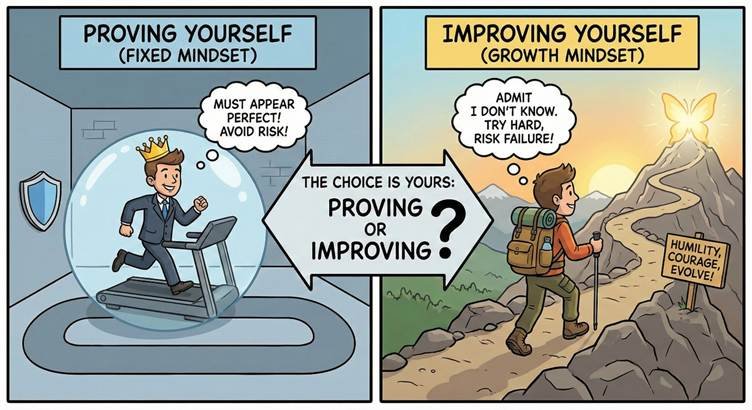
The view you choose for yourself changes the way you lead your life. You can choose the safety of the Fixed Mindset, where you must constantly prove you are special, hide your flaws, and avoid anything that might make you look weak. But in that world, you will always be running in place. Or, you can choose the Growth Mindset, understanding that Talent is Overrated. It is a path that requires you to be humble. It requires admitting you don’t know everything. It requires the bravery to try hard and risk failure. But it is the only path that allows you to truly grow. The choice is yours. Will you spend your life proving yourself, or improving yourself?
Credit / References
Book Name: Mindset: The New Psychology of Success
Author Name: Carol S. Dweck, Ph.D.
Note: The core psychological concepts, the distinction between Fixed and Growth mindsets, and the references to brain plasticity and specific academic studies (such as the Hong Kong University English class study) mentioned in this article are derived from the research and writings of Dr. Carol Dweck.
Copyright Disclaimer
This article is written for educational and informational purposes only.
No copyright infringement is intended.
All original ideas and concepts belong to their respective author(s).
For any concerns or queries, please contact: contact@mohitsidana.com
FAQs
1. Can I have a Growth Mindset in some areas and a Fixed Mindset in others?
Yes, absolutely. Most people are a mix. You might have a Growth Mindset about your professional skills (believing you can learn new software) but a Fixed Mindset about your artistic ability (believing you just “can’t draw”). The goal is to identify where your Fixed Mindset is hiding and holding you back.
2. Is the Fixed Mindset simply a lack of confidence?
Not exactly. People with a Fixed Mindset can be very confident—as long as they are winning. However, their confidence is fragile because it depends on being perfect. The moment they fail or face a struggle, their confidence collapses. Growth Mindset confidence is more durable because it is built on the belief that you can learn, not that you are already perfect.
3. Is it possible to change my mindset as an adult?
Yes. Just knowing that these two mindsets exist is the first step toward change. By consciously choosing to view challenges as opportunities to learn rather than threats to your ego, you can rewire your brain’s response to failure over time.
4. Does a Growth Mindset mean I have to try hard at everything?
No. It doesn’t mean you need to be the best at everything. It simply means you accept that if you want to improve at something, effort is the path. You decide where to invest that energy based on what you value most.
5. How do I help my children develop a Growth Mindset?
Be careful with how you praise them. Instead of saying, “You are so smart” (which praises a fixed trait), say, “I am so proud of how hard you studied for this test” (which praises the effort and process). This teaches them that effort, not innate talent, is the key to success.
For Next Chapter of this book (Click here)