


We have all heard the old saying that the path to true love never runs smooth. But let’s be honest—sometimes that path feels more like an obstacle course designed to make us trip, fall, and give up entirely.
Why is it that some people go through a terrible breakup and never truly recover, carrying baggage into every future relationship? Meanwhile, others face the exact same heartbreak but come out of it stronger, wiser, and ready to love again.
Is it luck? Is it chemistry? According to psychology, the answer lies in something much deeper: Your Mindset.
Specifically, whether you view yourself, your partner, and your relationship through a Fixed Mindset or a Growth Mindset.
In this post, we are going to dive deep into how these two mindsets shape our love lives, our friendships, and even how we handle social rejection.

The Tale of Two Breakups
To understand the difference, let’s look at a story of two different people facing the same painful situation.
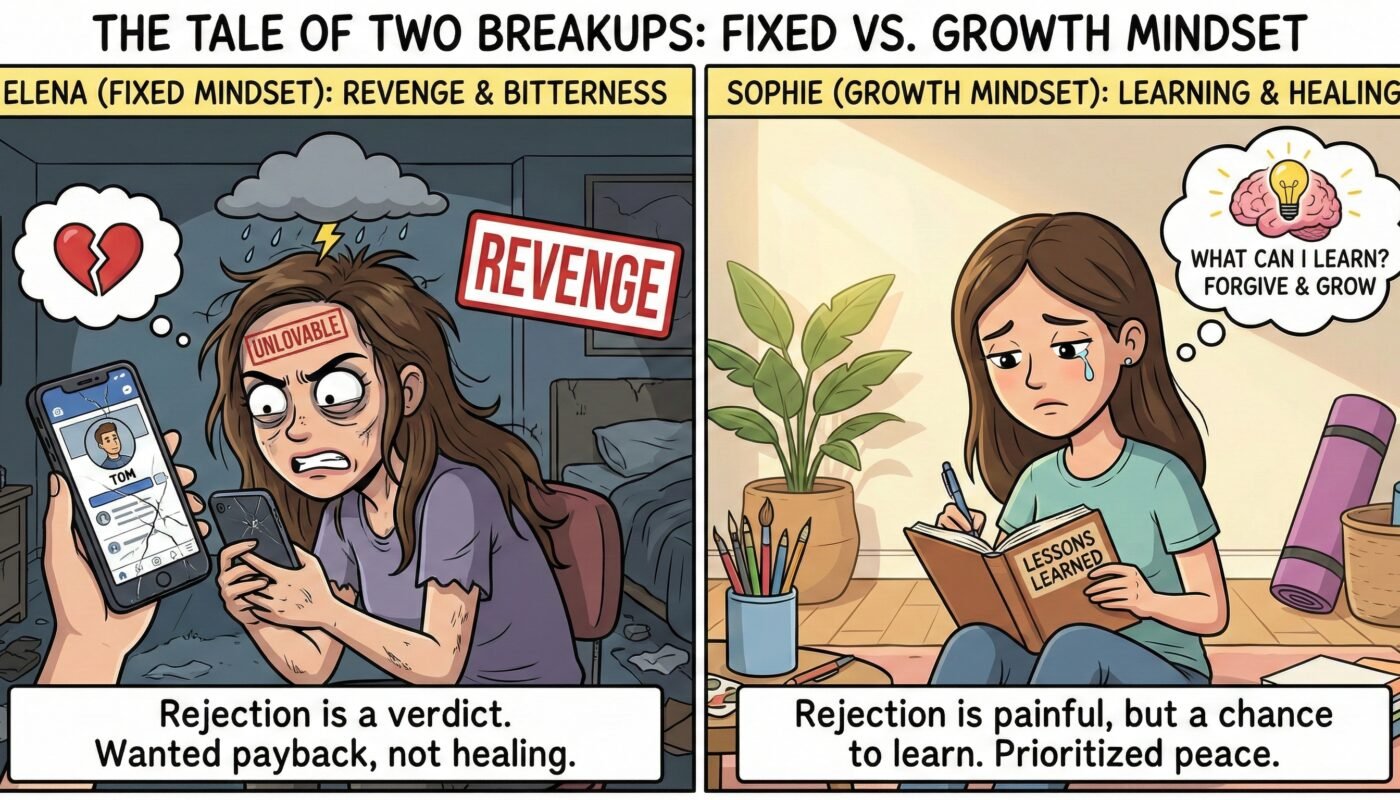
Imagine a woman named Elena. Elena met a man named Tom, and for two years, it was magic. They finished each other’s sentences, loved the same food, and moved in together. Then, one Tuesday afternoon, Elena came home to find Tom packing a bag. He told her he “needed space,” walked out the door, and ghosted her.
Elena’s Reaction (The Fixed Mindset):
Elena felt destroyed. But more than that, she felt judged. She believed that if Tom left, it meant she was unlovable. It was a permanent label stamped on her forehead. Because she couldn’t fix the internal wound, she turned outward. She wanted revenge. She spent months stalking his social media, hoping he would fail, and telling everyone who would listen that he was a monster. Her goal wasn’t healing; it was payback.
Now, let’s imagine Sophie. Sophie went through an almost identical situation. Her partner left abruptly after a long relationship.
Sophie’s Reaction (The Growth Mindset):
Sophie was heartbroken. She cried, she felt the loss deeply, and she struggled. However, Sophie didn’t feel permanently branded as “unlovable.” She looked at the relationship and asked, “What can I learn from this?” She realized that while they had chemistry, their communication was poor. She forgave him—not for his sake, but for her own peace of mind—and decided that in her next relationship, she would prioritize open dialogue. She picked up new hobbies and moved forward.
The Key Difference:
For the Fixed Mindset, rejection is a verdict on your worth. It leads to bitterness and a desire for revenge. For the Growth Mindset, rejection is painful, but it is a chance to learn, forgive, and grow.
The Myth of “Effortless Love”
One of the most dangerous beliefs in modern dating is the idea of “The One.”
People with a Fixed Mindset often believe that if a relationship is meant to be, it should be easy. They think compatibility is a static thing—you either have it, or you don’t. It’s the “Happily Ever After” syndrome.
When you believe in effortless love, two major problems arise:
1. The Fear of Work
If you believe that true love requires no effort, then the moment you and your partner have a disagreement, you panic. You think, “Oh no, we are fighting. That means we aren’t soulmates.”
People with a Growth Mindset know the truth: A lasting relationship comes from effort. It comes from working through differences. As relationship experts note, every marriage demands constant effort to keep it on track. It is not about finding a partner who is perfect; it is about finding a partner who is willing to do the work with you.
2. The Mind-Reading Trap
Have you ever thought, “If he really loved me, he would know why I’m upset”?
This is a classic Fixed Mindset trap. It assumes that couples should be so in sync that they can read each other’s minds. When your partner fails to guess what you need, you feel betrayed.
Example:
Imagine a couple, Mark and Lisa. Mark comes home quiet after a bad day. Lisa assumes Mark is mad at her (mind reading). She gets defensive and gives him the silent treatment. Mark, who just wanted to relax, feels rejected.
- The Growth Solution: Stop assuming. Ask questions. “I need more support right now” is not a sign of a weak relationship; it is a sign of a mature one.

Turning Partners into Enemies
When things go wrong, who do you blame?
In a Fixed Mindset, problems are seen as character flaws. If your partner forgets to take out the trash, they aren’t just forgetful—they are “disrespectful” and “lazy.” You assign a permanent negative label to them.
Once you label your partner as “bad” or “flawed,” you start to treat them like an enemy. You feel contempt. And once contempt enters a relationship, it is very hard to get it out.
The “Maurice” Technique
The book suggests a brilliant way to handle the urge to blame. When something goes wrong, instead of blaming your partner’s character, create an imaginary third party to blame. Let’s call him “Maurice.”
- “Did you lose the keys?”
- “No, Maurice must have moved them!”
It sounds silly, but it breaks the tension. It allows you to tackle the problem together rather than attacking each other. The Growth Mindset allows you to say, “This is a problem we are having,” rather than “You are the problem.”

Friendship, Shyness, and Social Growth
This mindset shift doesn’t just apply to romance; it controls your social life too.
Many of us struggle with shyness. We worry about walking into a party where we don’t know anyone. We fear looking stupid or awkward.
The Research on Shyness:
Researchers found that shyness affects people with both mindsets. However, their reaction to shyness is completely different.
- Fixed Mindset Shyness: They view the social interaction as a test. They are terrified of being judged. This fear makes them act cold, distant, or awkward, which often pushes people away—confirming their fear that they aren’t likable.
- Growth Mindset Shyness: They feel nervous too! But, they view the party as a challenge to master. They force themselves to say hello. As the night goes on, their anxiety drops, and they actually become more socially skilled.
The Lesson:
Social skills are not something you are born with. They are something you develop. If you are shy, don’t accept it as your identity. Treat it as a skill to be practiced.

The Bully and The Victim
Finally, we have to talk about the darkest side of the Fixed Mindset: Bullying.
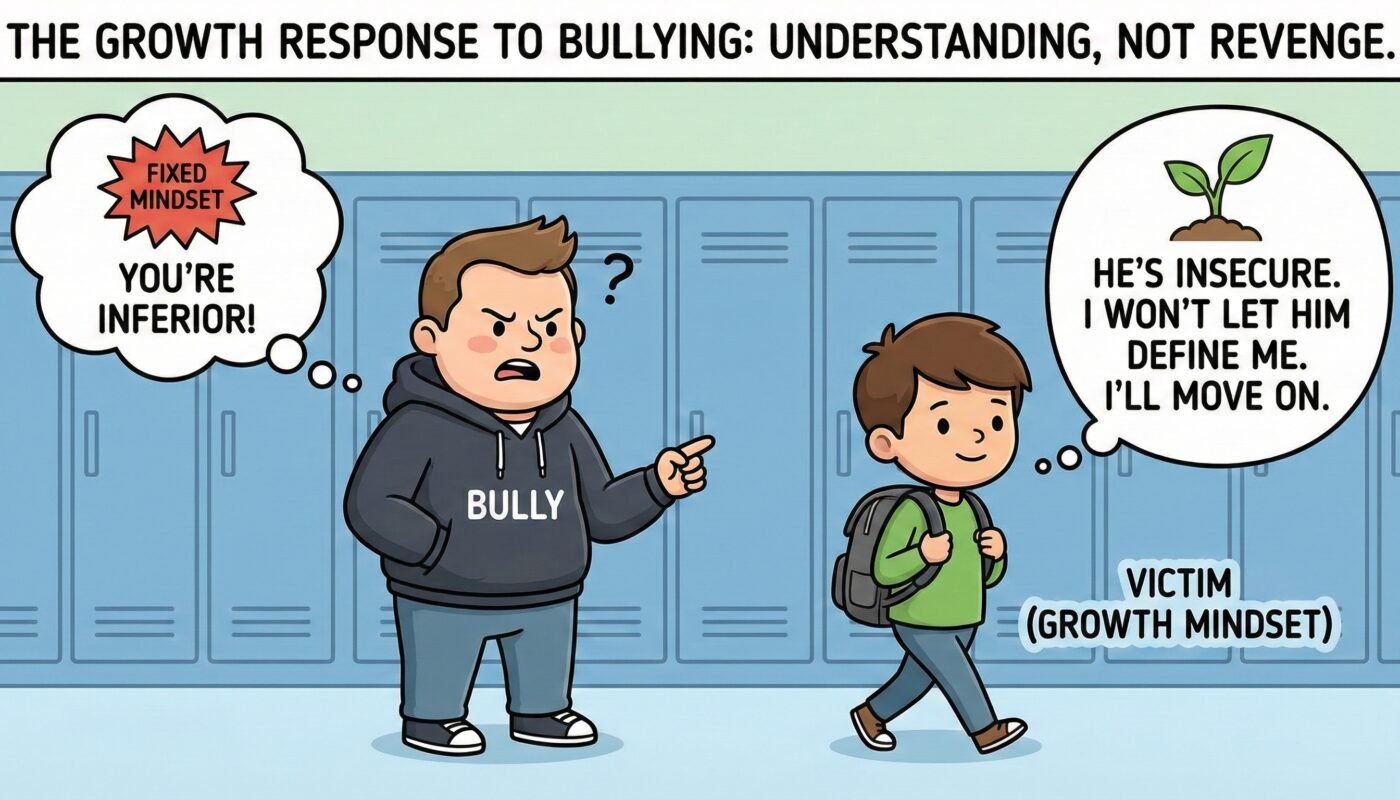
Bullying is essentially a judgment. The bully believes that some people are superior and some are inferior. By degrading others, the bully gets a temporary rush of self-esteem. They judge you to make themselves feel higher.
But victims can fall into the Fixed Mindset trap too. When bullied or rejected, a victim with a Fixed Mindset often fantasizes about violent revenge. They want to judge the bully back.
The Growth Response to Bullying:
Students with a Growth Mindset see things differently. They don’t let the bully define them. They realize the bully is acting out of their own insecurity. Instead of revenge, they often want to educate the bully or simply move on.
Schools that have successfully reduced bullying didn’t just punish the bad kids. They changed the culture. They stopped labeling kids as “bullies” (a fixed trait) and started praising inclusive behavior (effort and growth).
Conclusion: You Can Choose Your Mindset
Here is the good news: You are not stuck with your current mindset.
If you recognized yourself in the descriptions of the Fixed Mindset—if you hold grudges, expect mind-reading, or fear social judgment—you can change.
- Practice Forgiveness: Not because the other person deserves it, but because you deserve to be free of the past.
- Embrace the Work: Stop looking for a fairytale. Start building a partnership.
- Drop the Labels: Stop calling yourself “unlucky in love” or “shy.” Start saying, “I am learning how to communicate better.”
Relationships are the ultimate school for personal growth. Choose to learn, and you will find that love isn’t just something you find—it’s something you build.

Credit / References
Book Name: Mindset: The New Psychology of Success
Author Name: Carol S. Dweck, Ph.D.
This article explores concepts and research presented by Carol S. Dweck in her seminal book. All stories and examples in this blog post have been rewritten and adapted for illustrative purposes, while maintaining the core psychological principles discovered by the author.
Copyright Disclaimer
“This article is written for educational and informational purposes only.
No copyright infringement is intended.
All original ideas and concepts belong to their respective author(s).
For any concerns or queries, please contact:
contact@mohitsidana.com”
FAQs
1. Can a relationship work if one partner has a Fixed Mindset and the other has a Growth Mindset?
Yes, it is possible, but it requires patience. The partner with the Growth Mindset often has to lead by example, showing that conflicts can be solved without blame. Over time, this can help the Fixed Mindset partner feel safe enough to open up and grow, though both must eventually be willing to put in the effort.
2. Why do I always feel the need to blame my partner when things go wrong?
This is a classic defense mechanism of the Fixed Mindset. Blaming your partner protects your own ego from feeling “flawed.” By shifting to a Growth Mindset, you realize that making a mistake doesn’t make you a bad person, which makes it easier to accept responsibility and solve the problem together.
3. Is it true that “if it’s meant to be, it will be easy”?
No, this is a myth. Relationship experts and psychologists agree that all long-term, healthy relationships require consistent effort, communication, and compromise. Expecting a relationship to be effortless often leads to disappointment when normal challenges arise.
4. How can I stop being so shy in social situations?
Try to shift your focus from “being judged” to “learning.” Instead of worrying about what people think of you, view the social event as a challenge to meet one new person or learn one new thing. Remind yourself that social skills are learned, not innate.
5. How do I forgive someone who hurt me deeply?
Forgiveness in the Growth Mindset isn’t about saying what they did was okay. It is about deciding that you will not let the past define your future. It involves seeing the situation as a learning experience that taught you what you do and don’t want in a relationship, allowing you to move on.