

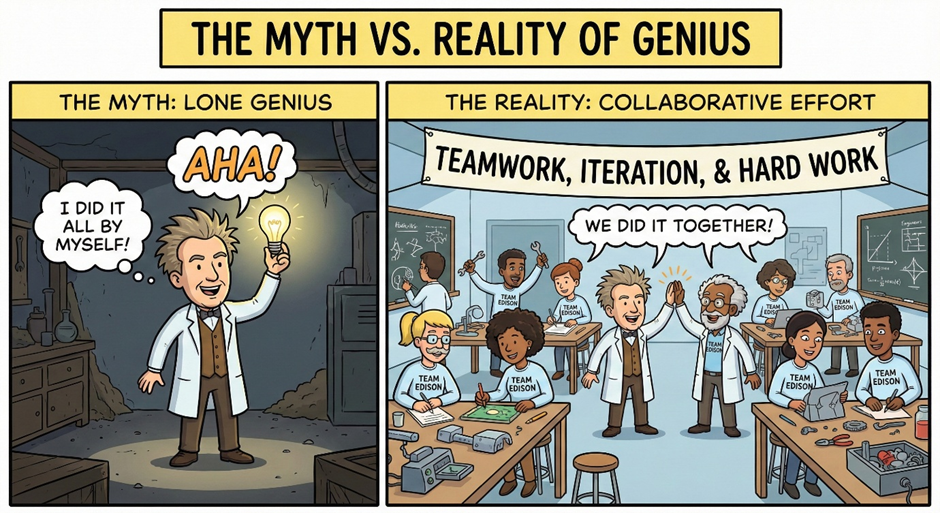
We all have a specific image in our heads when we think of a “Genius.”
Picture Thomas Edison inventing the lightbulb. You probably imagine a lonely person, late at night in a dirty room, working alone until—flash!—a sudden moment of smarts changes the world.
It is a nice image. It is also completely false.
The reality? Edison was a smart businessman who ran a huge, rich laboratory. He didn’t work alone; he had a team of thirty scientists, math experts, and engineers working all the time. The lightbulb wasn’t a single “aha!” moment; it was a hard, long process of chemistry and engineering fixes.
Why does this difference matter? Because the “Myth of the Lone Genius” builds The Smart Trap that destroys our potential.
When we believe that great wins come from natural magic, we set ourselves up for failure. We start to believe that if we have to work hard at something, we must not be “gifted.”
In this article, we will explore the psychology of success, why “being smart” is a dangerous label, and how escaping The Smart Trap can unlock power you didn’t know you had.
The Transition Crisis: When “Natural Talent” Hits a Wall
Let’s look at a common story that happens in schools every year. It usually happens during a big change—like moving from elementary school to junior high, or high school to college.
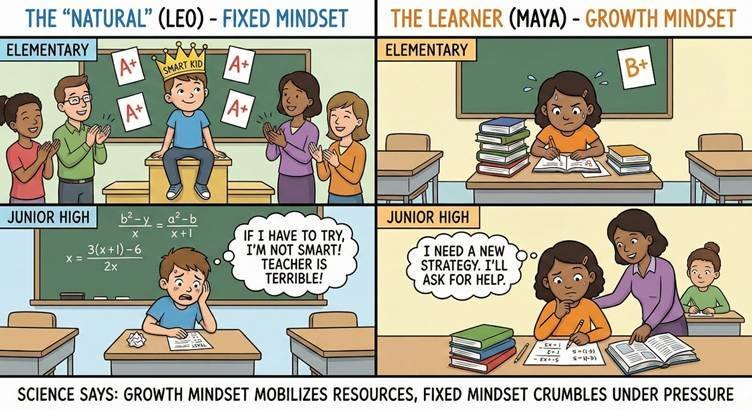
Consider two students: Leo and Maya.
In elementary school, Leo was the “smart kid.” He never studied, yet he always got A’s. He loved the praise of his teachers and parents. He built his life around being a natural.
Maya, on the other hand, always had to work for her grades. She was a B-student who sometimes got an A through hard work and extra credit.
Then comes Junior High. Suddenly, the math gets hard, the teachers are less kind, and the grading is tough.
The Crash of the “Natural”
When Leo hits his first hard problem in Algebra, he panics. To Leo, having to try hard means he has fallen into The Smart Trap—he thinks effort proves he isn’t smart anymore. To save his feelings, he quits. He tells himself, “This teacher is terrible,” or “Math is stupid anyway.”
Leo stops trying. Why? Because if he tries hard and fails, it proves he isn’t a genius. But if he doesn’t try and fails, he can say, “Well, I didn’t study.” It’s a defense trick called the Low-Effort Syndrome.
The Rise of the Learner
Maya, however, views this difficulty differently. She doesn’t see a bad grade as a definition of her soul; she sees it as feedback. She thinks, “Okay, my old way of studying isn’t working. I need to ask the teacher for help or find a new plan.”
Maya’s grades actually get better during this change, while Leo’s drop.
The Science Behind the Story
Psychologists have tracked thousands of students through these changes. They found that students with a Fixed Mindset (like Leo, who believes brains are set in stone) crumble under pressure because of The Smart Trap. They blame teachers and lose interest.
Students with a Growth Mindset (like Maya, who believes brains can be grown) use their tools. They don’t label themselves as “dumb”; they just recognize they haven’t learned it yet.
The Danger of Praise: Feeding The Smart Trap
If we want our children, employees, or even ourselves to succeed, we naturally want to give praise. We say things like:
“You learned that so fast! You’re a natural!”
“Wow, you got an A without studying? You are brilliant!”
It feels like we are building confidence. In reality, we might be building The Smart Trap.
The IQ Test Experiment
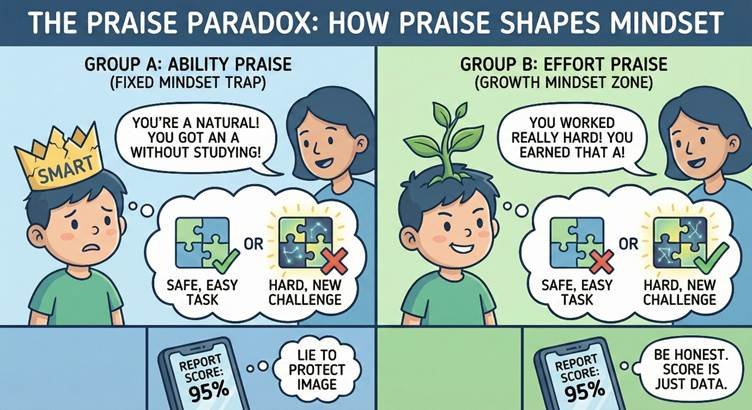
In a famous study involving hundreds of young students, researchers gave students a set of hard problems from a puzzle test. Most students did well.
Then, the researchers divided the students into two groups for praise:
Group A (Ability Praise): “Wow, you got a high score. You must be really smart at this.”
Group B (Effort Praise): “Wow, you got a high score. You must have worked really hard.”
The results were shocking.
The Impact on Mindset
The students praised for ability immediately became scared. When offered a choice for the next task, they rejected a hard new puzzle that they could learn from. They chose an easy task where they could keep looking smart. They had fallen into The Smart Trap: If success means I’m smart, then struggling means I’m dumb.
The students praised for effort, however, wanted more. 90% of them chose the harder, challenging task. They wanted to learn.
The Lie
The study took a darker turn. Later, the researchers asked the students to secretly report their scores to students at other schools.
The effort-praised group was honest.
The ability-praised group lied. Almost 40% of them changed their scores to look better.
By telling them they were “smart,” the researchers had pushed them into The Smart Trap, making them feel so weak that they had to lie to protect that label.
Labels, Stereotypes, and The Smart Trap
This mental weakness explains why negative stereotypes are so bad.
We often hear that certain groups aren’t “good at math” or don’t “have the brain for science.” If you operate from a Fixed Mindset—believing that talent is a permanent thing you are born with—these stereotypes can hurt you.
Research by Claude Steele and Joshua Aronson shows that simply checking a box for “Race” or “Gender” before a test can lower the scores of high-performing minorities or women. The fear of proving the stereotype true eats up the brainpower needed to solve the problems.
But here is the solution: The Growth Mindset acts as a shield against The Smart Trap.
When you believe that ability is a muscle that grows with training, stereotypes lose their power. If someone says, “People like you aren’t good at math,” a Growth Mindset person thinks, “That’s just their opinion. If I want to be good at math, I can learn it.”
The “Artistic Gift” Illusion
We see this most clearly in art. Most people believe you can either draw, or you can’t.
But drawing isn’t a magical gift from the gods. It is a brain skill—specifically, the skill of seeing edges, spaces, and light.
In courses like Drawing on the Right Side of the Brain, adults who drew like children were taught these “seeing skills.” In just five days, their drawings went from simple scribbles to professional sketches. The “talent” didn’t change; their understanding of the process did.

How to Escape The Smart Trap (Practical Steps)
So, how do we move from the fragile world of “looking smart” to the powerful world of “becoming smarter”?
1. Change How You View Effort
Stop looking at effort as a weakness. If you see a worker or a student working hard, don’t think, “They must not be very good at this.” Realize that effort is the engine of success. Even Mozart wrote average music for ten years before he escaped The Smart Trap to write masterpieces.
2. Be Careful with Praise
Whether you are managing a team or raising kids, stop praising natural traits.
Don’t say: “You are a genius programmer.”
Do say: “I love how you fixed that code and found a new way to do it.”
Praise the strategy, the focus, and the work.
3. Reframe Failure
When you fail (and you will), catch your inner voice.
Fixed Voice: “I’m not good at this. I should quit before I look dumb.”
Growth Voice: “This is harder than I thought. I need to try a different way. Who can I ask for help?”
4. Reject the Labels
If you have been told you “aren’t a math person” or “aren’t creative,” reject that label. These are skills, not DNA. With the right teaching and hard work, your brain is capable of rewiring itself to master almost anything.

Conclusion
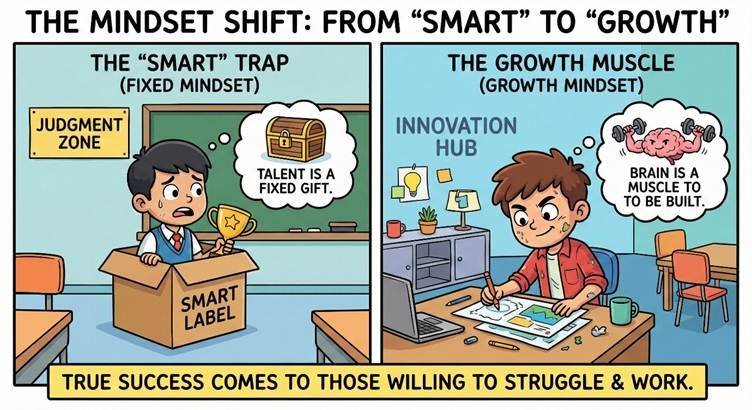
The belief that talent is a fixed, natural gift is one of the worst ideas in our society. It turns school into a place of judgment rather than learning. It turns workplaces into places of showing off rather than new ideas.
The Smart Trap is a prison. It feels good for a moment, but it boxes you in.
True success doesn’t come to those who are scared of losing their “genius” status. It comes to those who are willing to be confused, willing to struggle, and willing to work. It comes to those who realize that the brain is not a cup to be filled, but a muscle to be built.
Credit / References
Book Name: Mindset: The New Psychology of Success
Author Name: Carol S. Dweck, Ph.D.
Note: The psychological concepts, the specific studies regarding praise and IQ testing, the research on transition to junior high, and the references to researchers like Claude Steele, Joshua Aronson, and Benjamin Bloom mentioned in this article are derived from the research and writings of Dr. Carol Dweck.
Copyright Disclaimer
This article is written for educational and informational purposes only.
No copyright infringement is intended.
All original ideas and concepts belong to their respective author(s).
For any concerns or queries, please contact: contact@mohitsidana.com
FAQs
1. Is “talent” completely a myth? Are we all born the same?
No, we are not all born the same. Some children (prodigies) clearly start with high skills or strong interests. However, research shows that natural talent is just a starting point. Without avoiding The Smart Trap through curiosity and work, that talent often fades. Also, average potential can be turned into great success through effort.
2. Why do smart kids often struggle later in life?
This is often due to the “Fixed Mindset.” If a child coasts through early school without trying, they learn that “success = low effort.” When they finally hit a challenge that requires work (like college or a career), they feel like failures because they never developed the coping mechanisms or study strategies to handle difficulty.
3. How can I praise my child without hurting their mindset?
Focus on “Process Praise.” Instead of praising their intelligence (“You’re so smart”), praise their method (“I like how you studied for that test”), their persistence (“You didn’t give up even when it got hard”), or their strategy (“That was a clever way to solve that problem”).
4. Can adults change their mindset, or is it too late?
It is never too late. The brain keeps plasticity (the ability to change and grow) throughout life. By knowing your triggers for The Smart Trap—like getting angry when critiqued or avoiding new challenges—you can choose to use a Growth Mindset response.
5. Does the Growth Mindset mean I can be Einstein if I try hard enough?
Not necessarily. The Growth Mindset doesn’t claim everyone has the same potential. It simply claims that everyone’s potential is unknown and unknowable. It is impossible to predict what someone can achieve with years of passion, toil, and training.
For Next Chapter of this book (Click here)