

Have you ever wondered why some people seem to give up when they fail, while others treat a big problem like a fun puzzle waiting to be solved? It is easy to think that successful people are just born smarter, stronger, or more talented. We often look at an athlete, a CEO, or a great artist and think, “They have a special gift that I simply do not have.”
But psychological research suggests that the difference between winning and staying stuck is not usually about raw talent. It is about a specific belief system—The Invisible Wall inside your mind that controls how you see the world. This framework is called your Mindset. In this article, we are going to break down the two specific mindsets that control your life, how to see which one you have, and why removing The Invisible Wall could be the most important thing you ever do for your job and happiness.
The Tale of Two Students: A Modern Observation
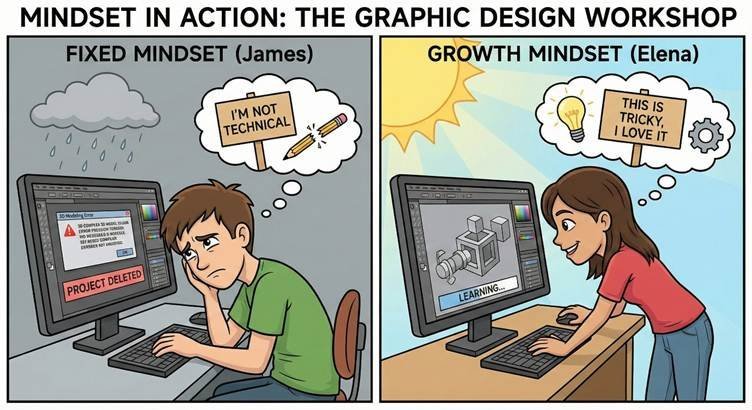
To understand this, let’s step away from boring theories and look at a real example. Imagine a graphic design class where a group of beginners is asked to learn hard computer software. It is difficult, annoying, and it breaks if you press the wrong button. Let’s look at two different students in this class: James and Elena. James is naturally smart. He is used to things being easy for him. But when the software shows an error, his face looks sad. He sighs, slumps in his chair, and thinks, “I am just not technical. This isn’t for me. If I was good at this, it wouldn’t be this hard.”
To James, The Invisible Wall has appeared, telling him he lacks the “gift.” Elena, on the other hand, is struggling just as much. She has deleted her project by mistake twice. But instead of slumping, she leans closer to the screen. She actually smiles a little and says to the teacher, “This is tricky. I love it. I need to figure out why that command didn’t work so I don’t do it again.”
To Elena, the struggle isn’t a stop sign; it is the path to getting better. What is the difference here? Is Elena smarter? No. The difference is that James views his skills as a fixed thing, while Elena views her skills as a muscle to be built.
Fixed vs. Growth: Facing The Invisible Wall
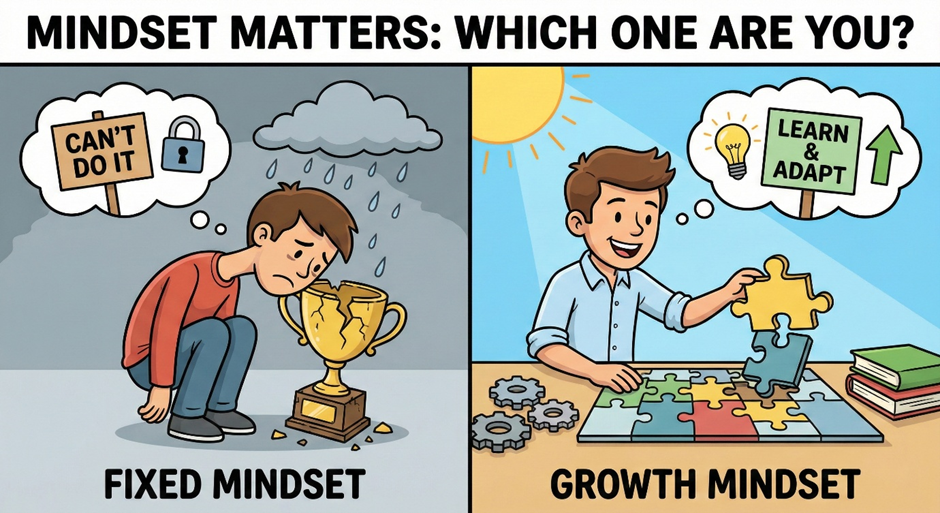
Psychologists and researchers have spent decades studying these reactions. Through many tests on children and adults solving problems, they found two main ways people view human skills.
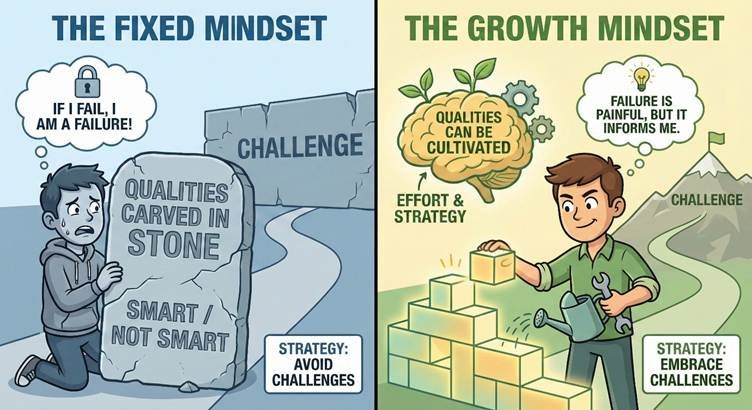
1. The Fixed Mindset People with a fixed mindset believe that their skills are carved in stone. You are either smart or you aren’t. You are creative or you aren’t. If you have this mindset, The Invisible Wall makes life feel like a never-ending test. You feel a strong need to prove yourself again and again. Every situation—a job interview, a date, a hard project—is judged on a pass/fail basis.
- The Fear: If I fail, it means I am a failure.
- The Strategy: Avoid challenges to look smart.
2. The Growth Mindset People with a growth mindset believe that their basic skills are just a starting point. They believe that talent and brains can be grown through work, plans, and help from others. They don’t believe that everyone is the same or that anyone can be Einstein, but they do believe that The Invisible Wall can be moved and a person’s true potential is unknown.
- The Belief: Failure is painful, but it doesn’t define me. It teaches me.
- The Strategy: Embrace challenges to get smarter and stronger.
The “Nature vs. Nurture” Myth
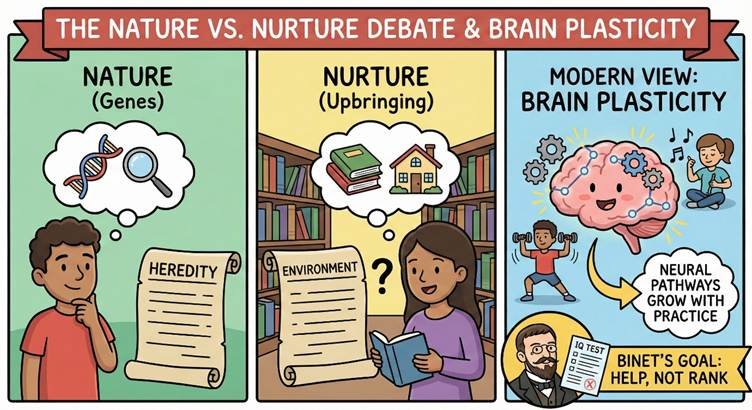
For hundreds of years, experts have argued about why people are different. Is it genes (Nature)? Or is it how we were raised (Nurture)? In the past, some scientists believed physical parts, like the shape of your skull, decided your future. Today, we often blame genes. However, many historic figures who supported intelligence testing actually believed the opposite.
The Truth About IQ Tests
Alfred Binet, the inventor of the IQ test, is often misunderstood. He didn’t make the test to rank children forever. He designed it to find which students were hitting The Invisible Wall so that schools could create new programs to help them improve. Binet believed that with practice and the right method, we can literally become smarter than we were before. Modern science backs this up. We now know the brain is “plastic”—it changes, grows new connections, and gets stronger based on how we use it.
The Invisible Wall Test: The “Bad Day” Simulation
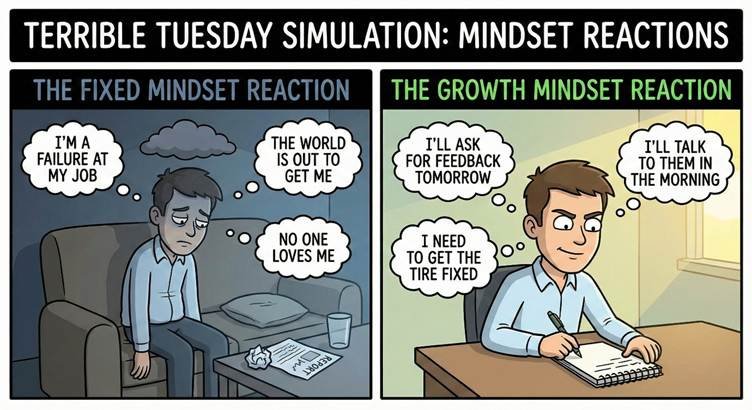
To see how these mindsets control your feelings, let’s run a test. Imagine you are having a terrible Tuesday:
- Work: You present a big report, and your boss gives it a so-so review, pointing out several mistakes.
- Commute: On the way home, you get a flat tire in the rain.
- Home: You complain to your partner, but they are busy and give you a short, rude reply.
The Fixed Mindset Reaction: If you operate from a fixed mindset, The Invisible Wall makes this day feel like a disaster. Your inner voice might sound like this:
- “I am a failure at my job.”
- “The world is out to get me.”
- “My partner doesn’t care about me. No one loves me.”
- Action: You might go to bed angry, drink too much, or stop talking. You avoid the report because it makes you feel dumb.
The Growth Mindset Reaction: A person with a growth mindset feels just as upset. It’s not that they enjoy flat tires or bad reviews! But their thinking is different:
- “I need to work harder on the data part of that report. I’ll ask the boss for help tomorrow.”
- “This tire is annoying, I need to get it fixed so I can get to work.”
- “My partner looks tired; they probably had a bad day too. I’ll talk to them in the morning.”
- Action: They face the problems directly rather than letting The Invisible Wall define who they are.
Why “Talent” Builds The Invisible Wall
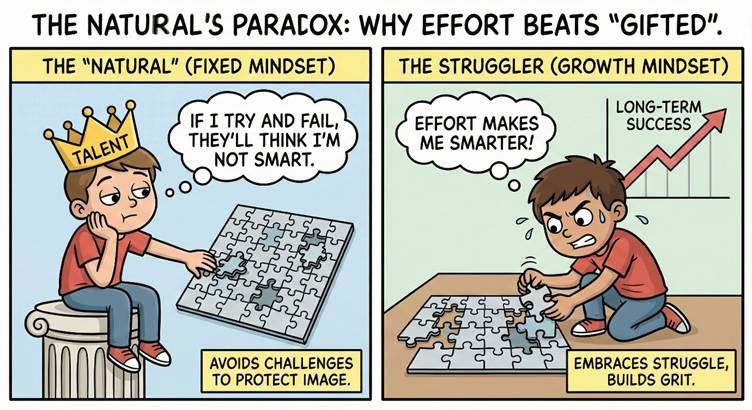
We often praise “naturals”—people who do things easily. But the fixed mindset creates a trap: if you believe you have to be “naturally” smart, you will eventually stop trying. Why? Because effort is for people who aren’t smart. If you have to try hard, it means you lack the gift. This is why many “gifted” children struggle later in life. They become so afraid of hitting The Invisible Wall and looking dumb that they stop taking risks. Meanwhile, the kids who had to fight for every grade often go past them, because they aren’t afraid of the struggle. They built the strength that the “naturals” never needed—until it was too late.
Self-Insight: Who Knows Themselves Better?
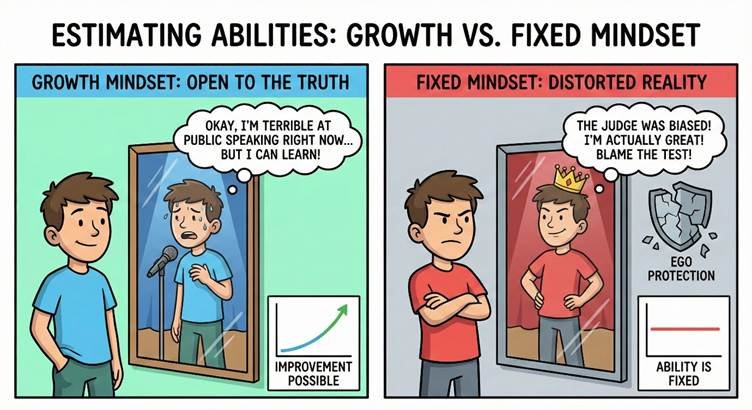
Here is a cool fact from psychological studies: People with a growth mindset are actually better at judging their own skills. Why? Because if you believe you can improve, you are open to the truth. You can look at your skills and say, “Okay, I am terrible at public speaking right now.” It doesn’t hurt your ego because you know you can break through The Invisible Wall. People with a fixed mindset, however, often hide from reality. If being “bad” at something means you are a “bad person,” your mind will lie to you. You will blame the judge, blame the test, or convince yourself you are better than you actually are to protect your feelings.
Breaking The Invisible Wall: The Choice is Yours
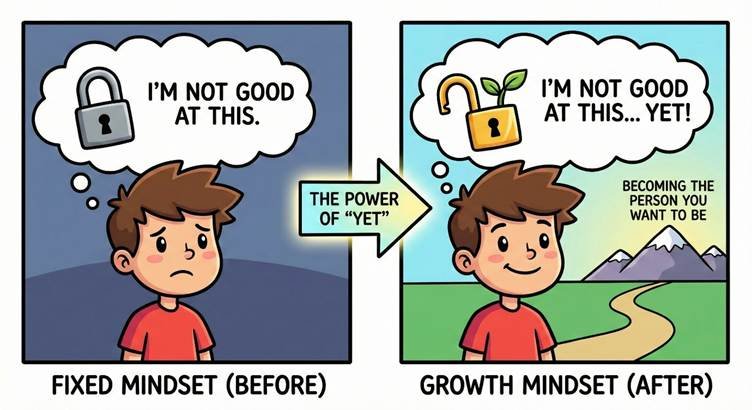
The most important point is that mindsets are not forever. You can have a fixed mindset in one area (like art) and a growth mindset in another (like sports). More importantly, you can change. Recognizing that you have been living behind The Invisible Wall is the first step. The next time you hear that voice in your head saying, “I’m not good at this,” add the word “yet.” “I’m not good at this… yet.” Success isn’t about proving how great you are. It’s about changing, stretching, and becoming the person you want to be.
Credit / References
Book Name: Mindset: The New Psychology of Success
Author Name: Carol S. Dweck, Ph.D.
Note: The core psychological concepts, the mention of Alfred Binet, and the study methodologies mentioned in this article are derived from the research and writings of Dr. Carol Dweck.
Copyright Disclaimer
This article is written for educational and informational purposes only.
No copyright infringement is intended.
All original ideas and concepts belong to their respective author(s).
For any concerns or queries, please contact: contact@mohitsidana.com
FAQs
1. Can I have both a Fixed and a Growth Mindset?
Yes, most people have a mix. You might have a growth mindset regarding your career (believing you can learn new skills) but a fixed mindset regarding your personality (believing “this is just who I am”). The goal is to see where The Invisible Wall is holding you back.
2. Is a Growth Mindset just about being positive?
No. It is not about blindly smiling through failure. It is about the specific belief that effort and strategy lead to improvement. It is about acknowledging the difficulty but believing the outcome isn’t permanent.
3. Can I change my mindset as an adult?
Absolutely. The brain remains “plastic” (changeable) throughout your life. By consciously catching your fixed-mindset thoughts and reframing them, you can rewire how your brain reacts to failure.
4. How do I help my child develop a Growth Mindset?
Focus your praise on process, not talent. Instead of saying “You are so smart,” say “I love how hard you worked to solve that problem.” Praise the strategy and the effort, not the innate ability.
5. Does a Growth Mindset guarantee success?
It doesn’t guarantee you will become Einstein, but it guarantees you will reach your own potential. It ensures that fear of failure won’t stop you from trying, which is the biggest part of The Invisible Wall.
For Next Chapter of this book (Click here)