



Have you ever looked at a successful person and thought, “They must be lucky,” or “They were just in the right place at the right time”?
We often look at wealth, fame, or career success as a lottery—something that happens to you. But if you peel back the layers of any great achievement, you rarely find luck. You find a specific state of mind.
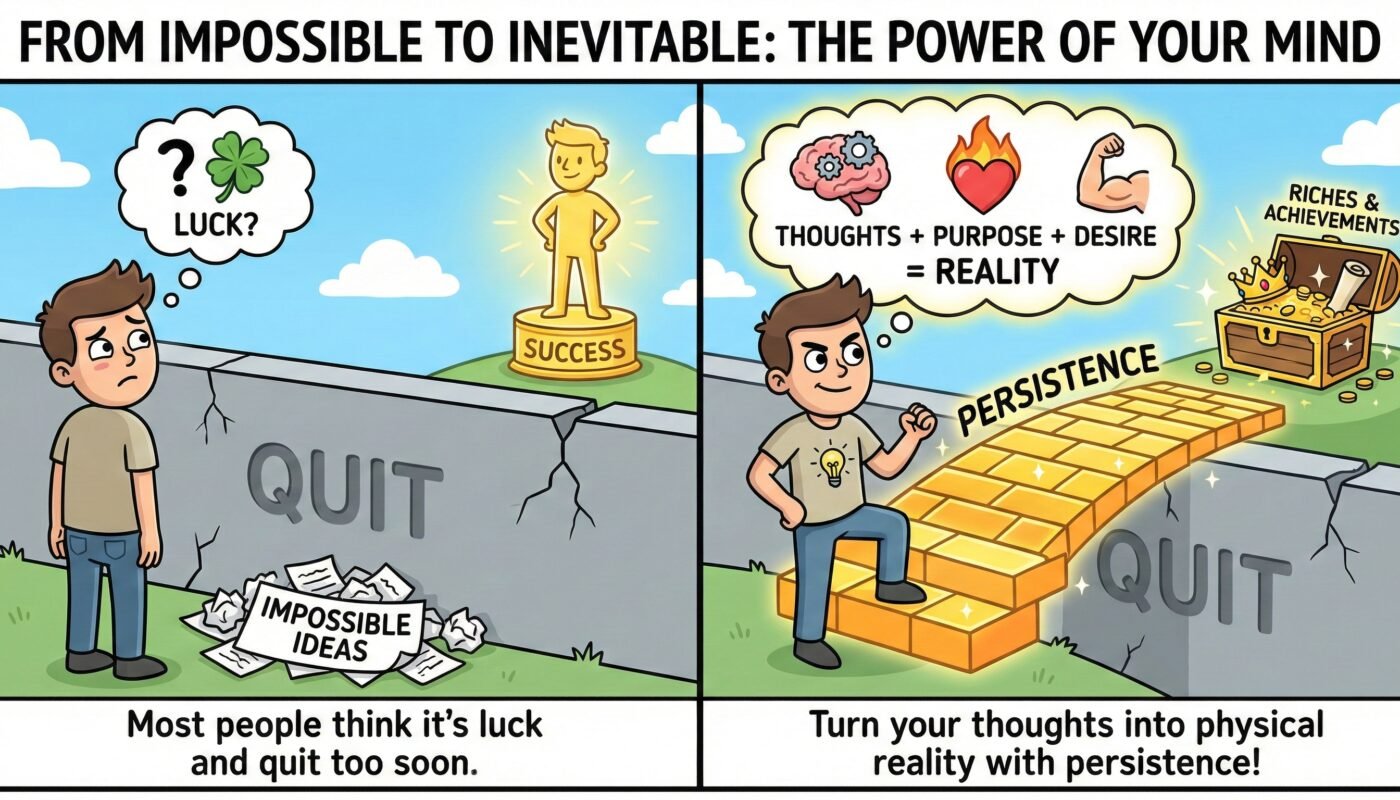
There is a powerful psychological truth that governs success: Thoughts are things.
They aren’t just wisps of smoke floating through your head. When you mix a thought with a definite purpose, persistence, and a burning desire, it transforms from a static idea into a physical reality. This isn’t magic; it’s a mechanical process of the human mind.
In this article, we will explore the foundational principles of success, why most people quit right before their big break, and how you can use the power of your mind to turn “impossible” ideas into inevitable riches.
The Principle of the “Burning Bridge”
To understand how thoughts become reality, we have to look at the difference between a “wish” and a “desire.”
Most people wish for money. They wish for a better job. They wish for fame. But a wish is passive. It has no legs. A burning desire is different. It is an obsession so strong that it leaves no room for failure.
The Story of Liam and the Mogul
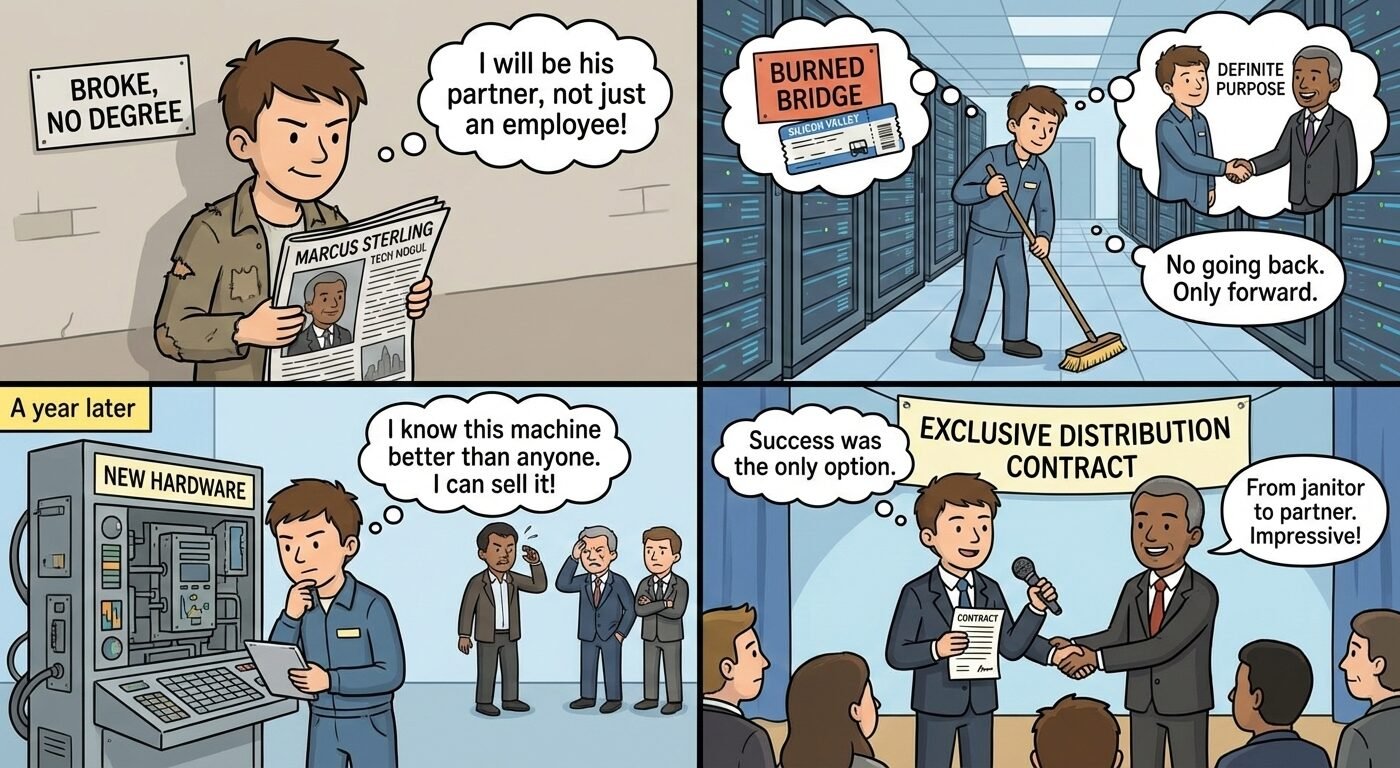
Let’s illustrate this with a modern example. Imagine a young man named Liam. He is broke, has no college degree, and wears cheap, ill-fitting suits. But Liam has an obsession: he wants to become the business partner of “Marcus Sterling,” the world’s most famous tech innovator.
Liam doesn’t want a job for Sterling. He wants to work with him.
Most people would send a resume and wait. Liam does something different. He spends his last $100 on a bus ticket to Silicon Valley. He shows up at Sterling’s headquarters with no appointment and no invitation.
When he finally gets inside, he doesn’t look like a partner; he looks like a lost tourist. He gets a job as a janitor sweeping the server rooms.
For months, Liam sweeps floors. But in his mind, he isn’t a janitor. He is a partner in training. He watches how Sterling works. He studies the business. He doesn’t look for other jobs. He mentally burns his bridges. He tells himself, “I will become a partner in this firm, or I will die trying.”
Two years later, Sterling invents a new, complicated piece of hardware that his sales team hates. They say it can’t be sold. Liam steps up. He knows the machine inside and out from his time observing. He asks for a chance to sell it. He sells thousands.
Sterling is so impressed he gives Liam an exclusive distribution contract. Overnight, the janitor becomes the partner.
The Lesson: Liam didn’t succeed because he was smart or lucky. He succeeded because he had a Definite Major Purpose and he cut off all possibility of retreat. He left himself only one option: Success.
The Tragedy of “Three Feet From Gold”
One of the most common causes of failure is the habit of quitting when overtaken by temporary defeat.
We often give up when things get hard. But the universe has a funny sense of humor: it often hides the biggest rewards just one step beyond the point where most people give up.
The Story of Maya’s Gold Mine
Imagine a woman named Maya who decides to start a specialty coffee business. She pours her life savings into it. She buys the best beans, rents a shop, and works 18-hour days.
For six months, nobody comes. She loses money every day. Her friends tell her, “You tried your best, maybe it’s time to quit.” Her bank account is empty. Exhausted and defeated, Maya sells her espresso machine and her lease to a “junk man” for pennies and walks away.
The “junk man” isn’t a genius, but he is curious. He hires a consultant to look at the shop. The consultant says, “Maya failed because she didn’t realize that a huge corporate office is opening next door next week. Thousands of customers will be walking past this door every morning.”
The junk man reopens the shop. One week later, the line is out the door. He makes millions.
The Lesson: Maya was literally “three feet from gold.” She quit because she mistook a temporary setback for a permanent failure. Before success comes, you will meet with temporary defeat. When you are overtaken by defeat, the easiest and most logical thing to do is to quit. That is exactly what the majority of people do—and that is why the majority are not rich.
Doing the “Impossible”
We are often held back by our own belief in what is possible. We listen to experts who tell us “it can’t be done.”
But history’s greatest achievements were created by people who ignored the word “impossible.”
The Story of the CEO and the Battery
Consider a fictional CEO of an electric car company. She wants to build a battery that lasts for 1,000 miles on a single charge. She calls her engineering team into her office.
“I want a 1,000-mile battery,” she says.
The engineers laugh. “That’s impossible,” they say. “The physics don’t work. It would be too heavy. It would overheat.”
The CEO doesn’t argue with the physics. She argues with their mindset. “Go ahead,” she says. “Stay on the job until you succeed, no matter how much time it takes. I want it, and I’ll have it.”
Six months go by. The engineers report back: “Still impossible.”
Another six months. “We can’t do it.”
The CEO refuses to accept their reality. She forces them to keep looking.
Driven by her relentless demand, the engineers stop looking at standard solutions and start looking for radical new materials. Suddenly, a breakthrough happens. They discover a new compound. The “impossible” battery is built.
The Lesson: The engineers knew what was currently true. The CEO knew what could be true. By refusing to accept the limitation, she forced the reality to bend to her desire.
Conclusion: You Are the Captain
The world we live in is not fixed. It is malleable.
Your bank account, your career, and your life are direct reflections of the dominant thoughts you hold in your mind. If you think you are beaten, you are. If you think you dare not, you don’t.
Success begins with a fellow’s will. It’s all in the state of mind.
To change your life, you must start by changing the signal you are broadcasting.
- Define exactly what you want. (Don’t just say “more money.” Say “I will earn $100,000 by next year.”)
- Decide what you will give in return. (There is no such thing as something for nothing.)
- Refuse to quit. When defeat comes, accept it as a signal that your plans are not sound, rebuild those plans, and set sail once more toward your coveted goal.
You are the master of your fate. You are the captain of your soul. But only if you take command of your thoughts.
Credit / References
Book Name: Think and Grow Rich
Author Name: Napoleon Hill
Note: The core principles of “Thoughts are Things,” “Burning Desire,” “Three Feet from Gold,” and the “Ford V8” story (retold here as illustrative analogies) are derived from the first chapter of Napoleon Hill’s classic text.
Copyright Disclaimer
This article is written for educational and informational purposes only.
No copyright infringement is intended.
All original ideas and concepts belong to their respective author(s).
For any concerns or queries, please contact: contact@mohitsidana.com
FAQs
1. What does “Thoughts are Things” mean?
It means that thoughts are not just abstract ideas; they are forms of energy. When you mix a thought with strong emotion (like desire or fear) and persistence, it magnetizes your brain to attract the physical equivalent of that thought. A thought of poverty attracts poverty; a thought of wealth attracts wealth.
2. Why is “Desire” different from “Wishing”?
A wish is a passive hope (“I wish I had a million dollars”). It has no power because you don’t really expect to get it. A desire is an active, pulsing obsession. It is a state of mind where you have convinced yourself that you will have it, and you are willing to burn all bridges to get it.
3. What is the “Three Feet From Gold” lesson?
This concept teaches that failure is often a trickster. It tends to trip you up right before your greatest success. Most people quit when they face temporary defeat, not realizing that the solution or the “gold” is just one step further.
4. Can anyone apply these principles?
Yes. The principles of success are not reserved for the educated or the wealthy. They are mental tools. Anyone who can control their mind, define a clear purpose, and persist through failure can use them to change their life.
5. Why do I need to “burn my bridges”?
If you have a “Plan B” (a safety net), your subconscious mind will naturally lean toward it when things get hard. Burning your bridges means cutting off all sources of retreat. It forces your mind to find a way to succeed because failure is no longer an option. This desperation creates the psychic energy needed for great achievement.