


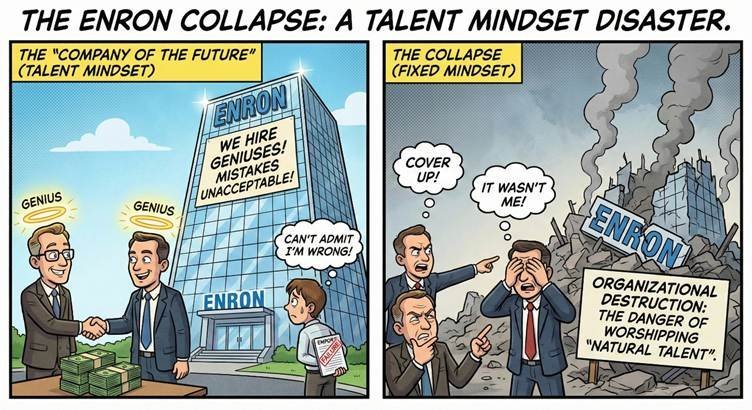
In 2001, the business world watched in fear as Enron—the “company of the future”—fell into a pile of dust. For years, experts tried to find out what went wrong. Was it just bad morals? Was it bad skill? Was it a lack of rules? According to psychological research, the main cause was something far more hidden and dangerous. It was a belief system. Enron had fallen into The Genius Trap. They believed that some people are born “geniuses” and others are not. They hired the absolute brightest stars, paid them huge money, and made a culture where being “smart” was the only thing that mattered.
This sounds like a good plan, right? Wrong. When you worship natural talent, you create The Genius Trap, a culture where mistakes are not allowed. If you are a “genius,” you cannot be wrong. If you are wrong, you aren’t a genius. So, when things inevitably went bad, Enron bosses couldn’t admit it. They couldn’t fix the path. They lied, hid things, and kept going until the ship sank. In this article, we will explore how the Fixed Mindset destroys companies, why the “Hero CEO” is a dangerous myth, and how the world’s most successful leaders use the Growth Mindset to build empires.
The Two Types of Leaders
Through deep research into big companies, psychologists have found two clear leadership styles coming from their mindset.
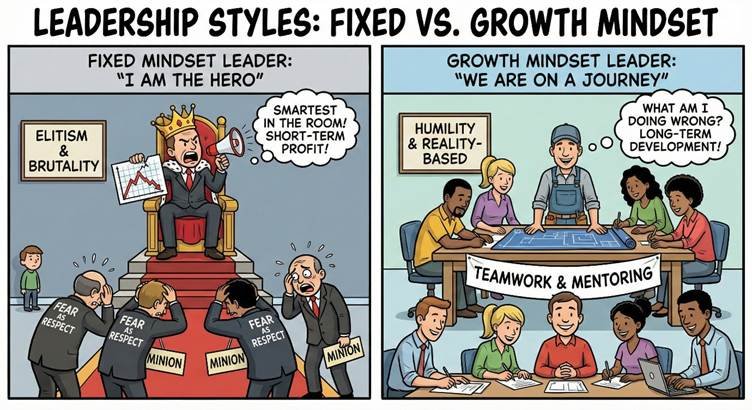
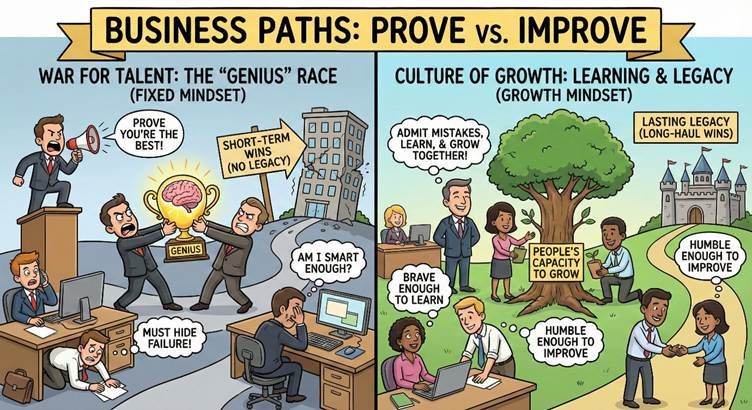
1. The Fixed Mindset Leader: “I Am the Hero” Leaders with a fixed mindset believe that their greatness is born in them. They need to be the smartest person in the room at all times. They don’t use the company to serve the customer; they use the company as a stage to show their own greatness.
The Symptoms of a Fixed Leader:
- Elitism: They create a “king” class within the company. They dislike the “little people” who actually do the work.
- Cruelty: They use shame to keep workers in line. They think fear is the same as respect.
- Stagnation: They focus on short-term money to boost their fame rather than long-term health.
- The “Genius with Helpers” Model: They don’t want a strong team; they want servants to do their brilliant ideas.
Historical Example: The “Chainsaw” Approach Consider the style of Albert Dunlap (often called “Chainsaw Al”). When he took over companies like Sunbeam, he didn’t try to build them for the future. He fired thousands of people to fake a high stock price, sold off parts, and claimed he was a “superstar” just like Michael Jordan. He wasn’t interested in learning the business; he was interested in proving his worth. In the end, the companies often fell apart after he left (or while he was there), because no foundation had been built.
2. The Growth Mindset Leader: “We Are on a Journey” Leaders with a growth mindset start with a belief in human power. They don’t assume they know everything. They are constantly asking questions, admitting they don’t know, and looking for people who know more than they do.
The Symptoms of a Growth Leader:
- Humility: They constantly look in the mirror and ask, “What am I doing wrong?”
- Growth: They love training and teaching. They want their workers to be better than them.
- Teamwork: They stop office politics and reward working together over individual fame.
- Reality-Based: They face the hard facts of failure right away so they can fix them.
Historical Example: The Turnaround of IBM When Lou Gerstner took over IBM in the early 90s, the company was old and stuck. It was filled with “royalty” and turf wars. Gerstner didn’t come in acting like a savior. He admitted what he didn’t know. He broke the elite groups, fired the politicians, and pointed the huge company at one thing: The Customer. He didn’t need to be the hero; he needed IBM to be the hero.
Groupthink: The Silent Killer of Innovation
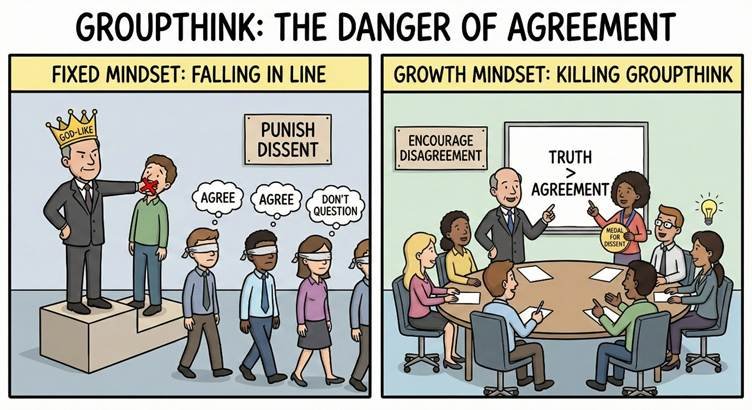
One of the deadliest side effects of The Genius Trap is Groupthink. When a leader punishes different ideas or acts like a god, employees stop thinking. They simply follow orders. They are afraid that if they ask a question, they will look “dumb” or “disloyal.” This is exactly what happened during big government failures in history. The advisors were so amazed by the leader’s “magic touch” that they stopped using their own judgment. No one wanted to be the one to say, “This is a bad idea.”
How to Kill Groupthink Growth mindset leaders actively fight against this natural habit.
Alfred P. Sloan (General Motors) once stopped a meeting because everyone agreed with him. He told them to go home, do more research, and come back when they had found some disagreement. David Packard (HP) once gave a medal to an employee who ignored a direct order because that employee was right and the boss was wrong. To create new things, you must create a culture where truth is valued more than agreement.
The Myth of the “Natural” Negotiator
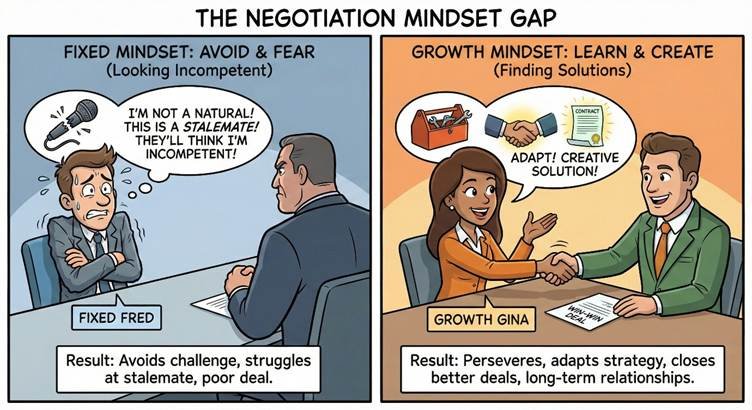
t isn’t just leadership; mindsets affect every skill in business, including making deals. Many people believe you are either born a smooth talker, or you aren’t. Studies have taught people either a fixed or growth mindset regarding deal-making skills.
The results were clear:
- Those with a Fixed Mindset avoided hard deals because they didn’t want to look weak, falling into The Genius Trap.
- Those with a Growth Mindset viewed deals as a learnable skill. They kept going through rough spots, changed their plans, and closed better deals.
- More importantly, the growth mindset negotiators didn’t just beat their opponents; they found smart answers that made both sides happy, leading to better long-term trust.
How to Build a Growth Culture in Your Company
If you are a manager, CEO, or owner, you might be asking: “How do I fix this?” It starts with how you view talent. If you run a “Culture of Genius,” you are telling your employees: “We hired you because you are smart. Don’t let us down.” This makes them scared of risk and secret. They will hide their mistakes to protect their status inside The Genius Trap. Instead, you must build a “Culture of Growth.”
1. Praise Effort and Strategy, Not Intelligence Stop giving awards for “pure genius.” Give awards for:
- Taking action.
- Learning from a huge mistake.
- Working with a difficult team.
- Teaching a new employee.
2. Treat Managers as Resources, Not Judges In Fixed Mindset companies, the boss is the judge and jury. In Growth Mindset companies, the boss is a source for learning. Managers should be trained to coach, not just to judge.
3. Embrace the “Yet” When an employee struggles, don’t give up on them. They haven’t mastered the skill yet. Provide the training, the feedback, and the time for them to get there.

Conclusion
The business world is obsessed with the “War for Talent.” But the companies that truly win over the long time aren’t the ones with the most “geniuses” on the payroll. They are the companies that believe in the power of their people to grow. They are the companies led by people who are humble enough to learn and brave enough to admit when they are wrong. You can choose to prove yourself, or you can choose to improve yourself. In business, only one of those paths escapes The Genius Trap.
Credit / References
Book Name: Mindset: The New Psychology of Success
Author Name: Carol S. Dweck, Ph.D.
Note: The concepts regarding Enron, the contrast between Fixed and Growth mindset leaders (such as Iacocca vs. Welch/Gerstner), the research by Collins, Wood, Bandura, Kray, and Haselhuhn, and the specific case studies mentioned in this article are derived from the research and writings of Dr. Carol Dweck.
Copyright Disclaimer
This article is written for educational and informational purposes only.
No copyright infringement is intended.
All original ideas and concepts belong to their respective author(s).
For any concerns or queries, please contact: contact@mohitsidana.com
FAQs
1. Can a company have a mindset?
Yes. A group develops a collective mindset based on what it rewards. If a company rewards natural talent and punishes mistakes, it creates The Genius Trap (Culture of Genius). If it rewards learning, mentoring, and risk-taking, it creates a Growth Mindset culture (Culture of Development).
2. Are leaders born or made?
Research by leadership gurus like Warren Bennis suggests that leaders are made. While some may have natural charisma, true leadership—the ability to guide an organization through trouble and foster growth—is a set of skills that must be learned and practiced.
3. Why do “Fixed Mindset” leaders often fail eventually?
Fixed Mindset leaders are often obsessed with their own image. When the company faces a challenge, they view it as a threat to their reputation. Instead of fixing the problem, they may blame others, hide data, or make short-term decisions to boost stock prices, eventually eroding the company’s foundation.
4. How can I identify a Growth Mindset candidate in an interview?
Don’t just look at their resume or pedigree. Ask questions like: “Tell me about a time you failed and what you learned from it,” or “How do you handle criticism?” Look for candidates who show a hunger for learning and a willingness to admit mistakes, rather than just those trying to prove how smart they are.
5. Is Groupthink related to mindset?
Yes. Groupthink lives in environments defined by The Genius Trap where the leader is viewed as a “god” who cannot be questioned, or where employees are afraid of looking stupid by disagreeing. Growth Mindset cultures encourage debate and view different ideas as a needed part of finding the right answer.
For Next Chapter of this book (Click here)