


We all want our children to be successful. Whether you are a parent, a teacher, or a coach, the goal is always the same: we want the people under our care to thrive, to be confident, and to achieve great things.
We would never intentionally discourage them. Yet, psychology tells us that many of the things we do with the best of intentions—the compliments we give, the way we console them after a loss, and the standards we set—might actually be holding them back.
Without realizing it, we often send messages that tell children: “Your talent is a fixed trait, and I am judging it.”
To truly help children grow, we need to shift our language. We need to move from a Fixed Mindset (believing abilities are set in stone) to a Growth Mindset (believing abilities can be developed).
Here is how you might be accidentally sending the wrong message, and exactly how to fix it.

The Dangerous Trap of “You’re So Smart!”
Imagine your child comes home with an A+ on a math test. You are thrilled. You hug them and say, “Wow! You learned that so fast. You are so smart!”
It sounds like perfect parenting, right? You are building their self-esteem.
However, research suggests this is actually one of the most damaging things you can say. When you praise a child’s intelligence or talent (“You’re a natural!”, “You’re a genius!”), you are handing them a label.
The unintended message the child hears is:
“If success means I am smart, then struggling must mean I am dumb.”
Children who are praised for being “smart” become terrified of challenges. They stop taking risks because they don’t want to lose that label. They would rather do something easy and look perfect than try something hard and risk making a mistake.
The Better Alternative: Praise the Process
Instead of praising the person (traits), praise the process (effort, strategy, focus).
Instead of: “You are a natural artist!”
Say: “I love the way you mixed those colors to make the sky look stormy. You really focused on the details.”
Instead of: “You got an A without even studying! You’re brilliant!”
Say: “You got an A, but it seemed too easy for you. I’m sorry I wasted your time. Let’s find something challenging that you can actually learn from.”
When you praise the process, you give the child a recipe for success. They learn that results come from work and strategy, not from magic DNA.

Handling Failure: The “False Comfort” Mistake
How we react when our children fail is just as important as how we react when they succeed.
Let’s look at a story. Imagine a young girl named Mia. Mia loves playing the piano. She practices for her first recital, but when the big night comes, she gets nervous. She hits a wrong chord, panics, and the rest of the song is a bit of a mess. She leaves the stage in tears, devastated.
As a parent, your instinct is to protect her. You might be tempted to say:
- “You were the best one up there!” (A lie).
- “The piano was out of tune; it wasn’t your fault.” (Blaming others).
- “Piano isn’t that important anyway.” (Devaluing the skill).
The Growth Mindset Approach
A parent with a Growth Mindset knows that false comfort doesn’t help. It just teaches the child that they are perfect as they are, or that the world is unfair.
Instead, Mia’s father sits her down and gives her a hug. He says:
“Mia, I know you are disappointed. It hurts to work hard and not perform the way you wanted to. But you know, you haven’t mastered that piece yet. Many of the other students have been playing longer, or they practiced that specific section more. If you want to be great at the piano, we need to look at your practice strategy and try again.”
This is Constructive Criticism. It validates her feelings but tells her the truth: Ability is the result of work.

The “False Growth Mindset”
Recently, there has been a misunderstanding about what the Growth Mindset actually is.
Some parents and teachers think it just means praising effort, no matter what. They see a student failing a math test and say, “Well, you tried your best!” while the student still doesn’t understand the material.
This is the “False Growth Mindset.”
The Growth Mindset is not about empty praise for effort that leads nowhere. It is about learning. If a child tries hard but still fails, we shouldn’t just say “good job.” We need to ask:
- “Okay, that strategy didn’t work. What can we try differently next time?”
- “Who can we ask for help?”
- “What part of this do you not understand yet?”
Effort is the key to the ignition, but strategy is the steering wheel. You need both to get the car moving.

Great Teachers: High Standards + Nurturing
Whether you are a classroom teacher or a parent teaching life skills, the formula for greatness is the same.
In the past, people thought you had to choose between being “strict” (high standards) or “nice” (low standards).
- The “Strict” Judge: Decides who is smart and who is dumb immediately. Teaches to the “smart” kids and ignores the rest.
- The “Nice” Enabler: Lowers standards so everyone feels good, resulting in poorly educated students.
The Growth Mindset Educator
The best educators, like the legendary Marva Collins (who taught “untouchable” inner-city kids to read Shakespeare), do both.
- They set incredibly high standards. They believe every single child is capable of genius-level work.
- They provide the ladder. They don’t just demand success; they nurture the student, teaching them how to reach those standards.
They say: “I am going to push you because I know what you are capable of. I will not let you give up on yourself.”

The Tale of Two Coaches
This mindset shift applies perfectly to sports coaching (and business leadership).
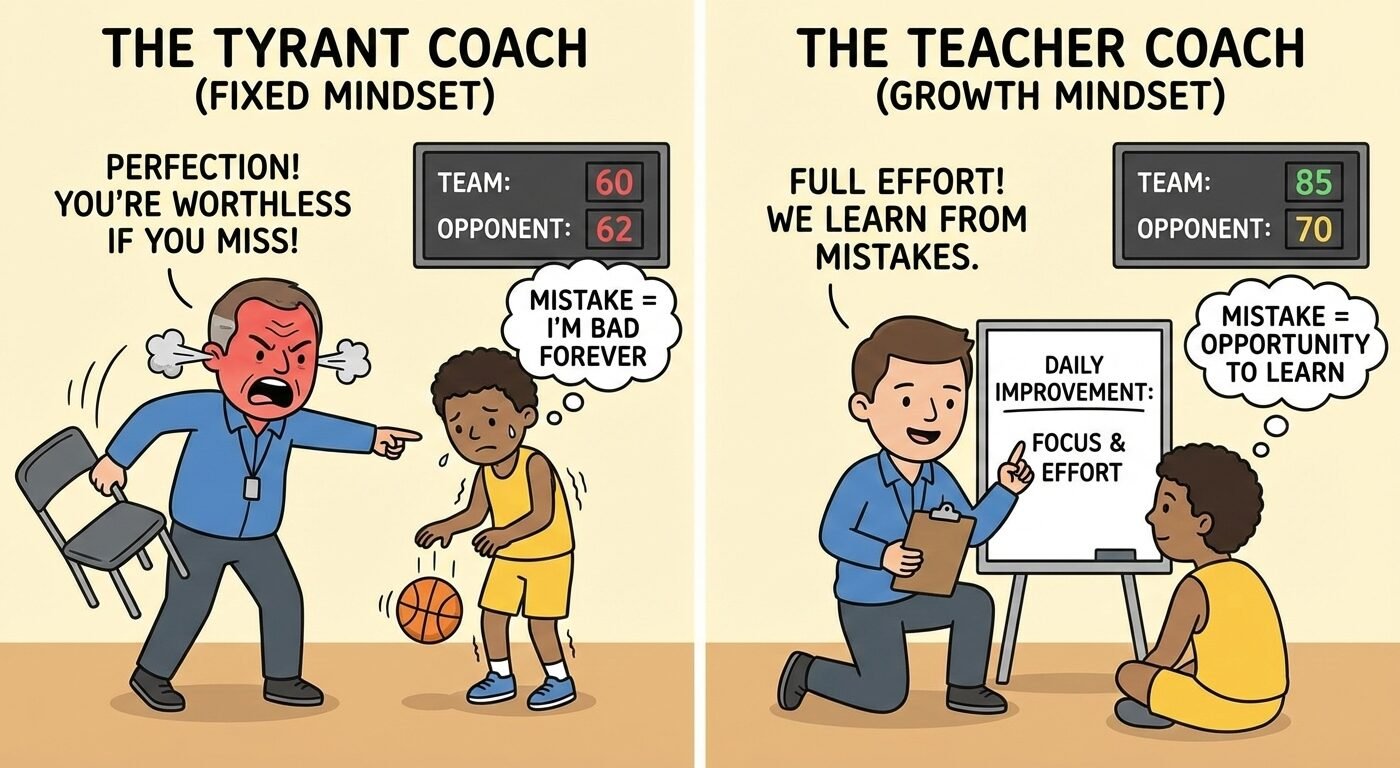
Think of a coach who is a Tyrant. This coach demands perfection. If a player makes a mistake, the coach screams, throws chairs, and humiliates them. This coach has a Fixed Mindset: he believes the mistake defines the player. He rules by fear. While he might win some games, he destroys the players’ love for the sport.
Now, think of a coach who is a Teacher, like the legendary John Wooden. Wooden didn’t ask for perfection; he asked for “full effort.” He treated the benchwarmers with the same respect as the star players. He focused on constant, daily improvement.
The result? His players didn’t just win championships; they became successful, well-adjusted human beings. They weren’t afraid of making mistakes in practice, which meant they improved faster than the players playing for the Tyrant.
Conclusion: It’s Not About What You Think, It’s About What You Do
You might have a Growth Mindset in your head. You might believe that anyone can change. But children don’t read your mind—they watch your actions.
They listen to what you praise.
They watch how you react when you make a mistake.
They notice if you judge others as “stupid” or “talented.”
Your Action Plan:
- Stop praising traits. Banish “You’re so smart” from your vocabulary.
- Start praising the process. “You worked hard on that,” “You found a great new way to solve that,” “You didn’t give up.”
- Treat failure as data. It’s not a verdict; it’s information on what needs to be fixed.
- Set high standards, but offer help. “This is hard, but I know you can do it, and I’m going to help you get there.”
We are entrusted with the lives of our children and students. The greatest gift we can give them isn’t a false sense of perfection, but the tools to love challenges and never stop growing.

Credit / References
Book Name: Mindset: The New Psychology of Success
Author Name: Carol S. Dweck, Ph.D.
This article explores concepts and research presented by Carol S. Dweck in her seminal book. All stories and examples in this blog post have been rewritten and adapted for illustrative purposes, while maintaining the core psychological principles discovered by the author.
Copyright Disclaimer
“This article is written for educational and informational purposes only.
No copyright infringement is intended.
All original ideas and concepts belong to their respective author(s).
For any concerns or queries, please contact:
contact@mohitsidana.com”
FAQs
1. Is it bad to tell my child they are smart?
Yes, surprisingly. While well-intentioned, praising intelligence makes children feel that their smarts are a fixed trait. This often leads to a fear of challenges, because they worry that if they struggle, they will no longer be seen as “smart.” It is better to praise the effort and strategies they used to solve a problem.
2. What should I say if my child fails a test?
Avoid saying “it doesn’t matter” or blaming the teacher. Instead, acknowledge their disappointment and focus on the future. Ask questions like, “What study strategies did you use?” and “What can we do differently next time to understand the material better?” This turns failure into a learning opportunity.
3. Can a person have both a Fixed and Growth Mindset?
Absolutely. Most of us are a mix. You might have a Growth Mindset about your hobbies (believing you can improve with practice) but a Fixed Mindset about your intelligence or personality. The goal is to recognize when you slip into a Fixed Mindset—usually triggered by stress or failure—and consciously shift back to growth.
4. What is the “False Growth Mindset”?
This occurs when parents or teachers praise effort even when there is no learning or progress. Simply saying “good try” when a child is stuck isn’t helpful. A true Growth Mindset involves trying new strategies and seeking help when sheer effort isn’t working.
5. How can I help a child who is hard on themselves?
If your child says, “I’m so stupid” when they make a mistake, correct the narrative immediately. You can say, “You aren’t stupid; you just haven’t learned how to do this specific thing yet.” The word “yet” is very powerful in shifting perspective from permanent failure to temporary struggle.