


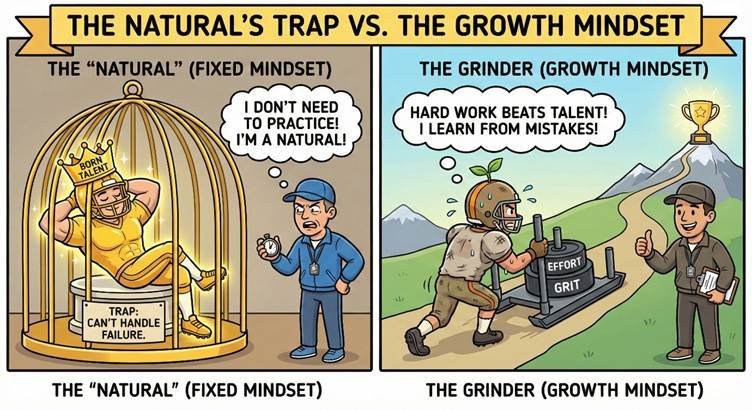
In the world of sports, we are obsessed with the idea of the “Natural.” You know the type. The athlete who walks onto the field and wins without breaking a sweat. The player who has the perfect body, the perfect swing, or the perfect run. We look at them and think, “They were born for this.” Scouts hunt for them. Teams pay millions for them.
But there is a hidden danger in this, which we call The Curse of the Natural. When you believe you are born with greatness, you often never learn how to work for it. And more importantly, you never learn how to handle it when things go wrong. In this article, we are going to explore why raw talent is often a trap, why the greatest athletes in history were actually the hardest workers, and how the “Growth Mindset” is the only true way to beat The Curse of the Natural.
The Tragic Tale of the “Sure Thing”
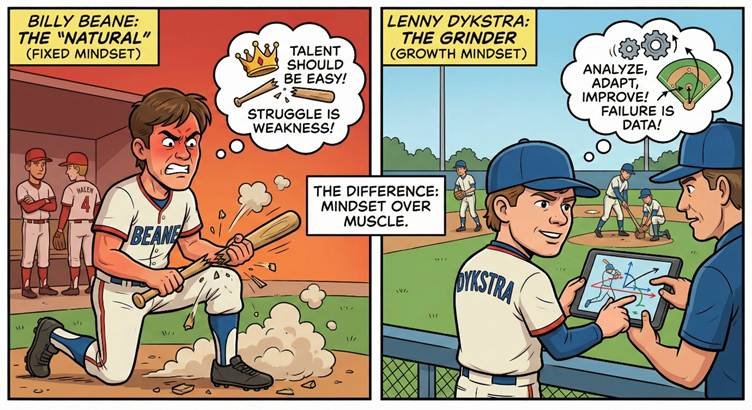
Let’s look at the story of Billy Beane. In high school, Billy was the definition of a genius player. He was the star quarterback, the best scorer in basketball, and a baseball hitter doing amazing things. Scouts agreed: He was the next superstar. But Billy had a huge problem: The Curse of the Natural.
He had a Fixed Mindset. Because everything came easily to him, he believed talent was something you either had or you didn’t. So, when he eventually reached the Major Leagues and faced real tests, he fell apart. Every time he struck out, he smashed his bat. He didn’t look for ways to fix his swing; he looked for things to break. Billy believed that if you had talent, you shouldn’t need to struggle. Struggle was for the weak.
Contrast this with his teammate, Lenny Dykstra. Lenny was half as strong as Billy was. But Lenny had no concept of failure. If he struck out, he checked why. If he lost, he practiced harder. Billy Beane watched in shock as Lenny—the guy with less “talent”—went past him. Billy Beane eventually realized the truth, not as a player, but later as the famous General Manager of the Oakland A’s (the story behind Moneyball). He realized that teams were caring too much about “looks” and “talent” and forgetting about the mindset needed to break The Curse of the Natural.
The Illusion of Physical Perfection
We often think we can see talent with our eyes. We measure height, reach, and muscles. But history has proven that this “Tape Measure Test” is often garbage.
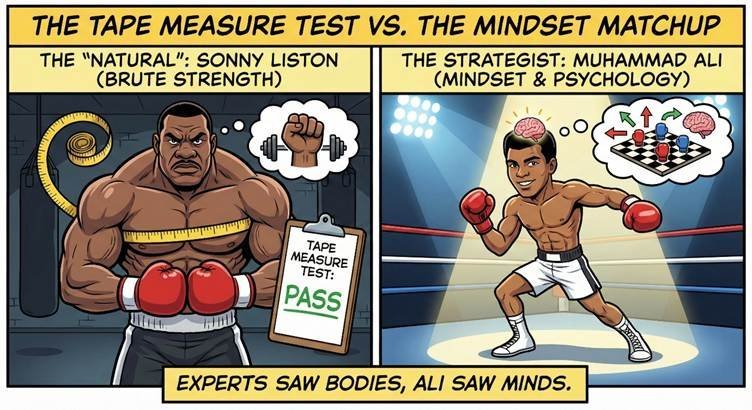
Muhammad Ali vs. Sonny Liston
On paper, Muhammad Ali (then Cassius Clay) shouldn’t have had a chance against Sonny Liston. Liston was a giant—a true natural with huge power. Ali, by boxing rules, did everything wrong. He held his hands too low and pulled his head back to dodge punches (a big mistake). But Ali wasn’t fighting with his body; he was fighting with his brain. While Liston used his raw strength, Ali studied Liston’s mind. He realized that to beat a “monster,” you have to make him think you are crazy. Ali used mind games and smart plans to beat a stronger opponent. The experts saw a mismatch of bodies. Ali saw a mismatch of minds.
Busting the Myth of the “Gods”
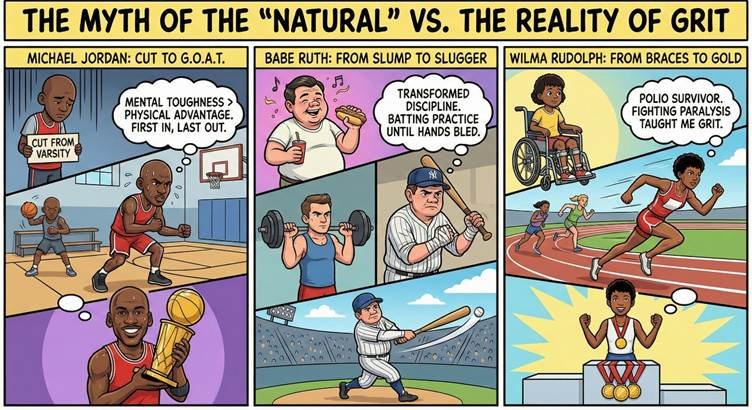
We tend to rewrite history to make our heroes seem like gods. We tell ourselves, “Michael Jordan was born to fly,” or “Wilma Rudolph was born to run.” It makes us feel better about our own lack of success and The Curse of the Natural. But when you look at the facts, the “Gods” were actually just the hardest workers in the room.
1. Michael Jordan We all know Jordan as the greatest. We forget that he was cut from his high school team. We forget he wasn’t the first pick in the NBA draft. Jordan didn’t start as a genius; he built himself into one. Even at the top of his fame, when he was arguably the best on the planet, he was still the first person at practice and the last one to leave. He once said the mental strength to get through failure was far more valuable than any physical gift he had.
2. Babe Ruth The story of the Babe is that he was a partying, eating natural who just rolled out of bed and hit home runs. The reality? When his career hit a low point in 1925, Ruth spent the entire winter in the gym. He changed his body and focus, leading to a comeback where he averaged 50 home runs a year. He was known to take batting practice until his hands bled—something the victims of The Curse of the Natural on his team hated him for.
3. Wilma Rudolph The “fastest woman on earth” was born early, sick, and fought polio as a child. She wore a leg brace until she was twelve years old. Doctors said she might never walk normally. She didn’t win because of superior genes; she won because fighting through paralysis taught her a level of grit that no other runner on the track had.
Character: The Art of Digging Deep
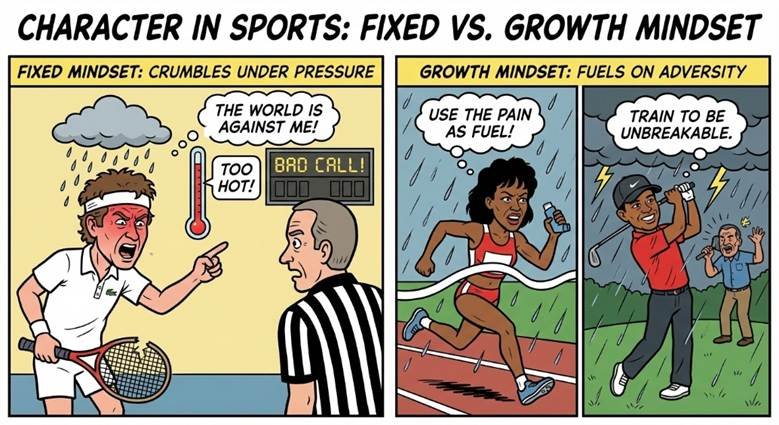
If talent gets you to the top, character keeps you there. In sports (and business), character isn’t just about being a “nice person.” It is the ability to perform when everything is going wrong. The Fixed Mindset athlete—suffering from The Curse of the Natural—often falls apart when things aren’t perfect. If it’s too hot, too cold, or if the referee makes a bad call, they quit. They feel the world is fighting against their genius. The Growth Mindset athlete—like Jackie Joyner-Kersee—uses hard times as fuel.
- When Joyner-Kersee had an asthma attack during a World Championship race, she didn’t quit. She talked herself through it, moving her arms, winning the race by will alone.
- When Tiger Woods was winning games, he was known for practicing in the worst possible places. He would have his father make loud noises during his swing or throw things to break his focus. He trained himself to be unbreakable.
Redefining Success: It’s Not About the Trophy
Here is the biggest difference between the two mindsets: Their definition of success. For the Fixed Mindset athlete, success is about proving you are better than everyone else. It’s about the trophy, the praise, and the ego boost. If they win, they are “Somebody.” If they lose, they are “Nobody.” For the Growth Mindset athlete, success is about the effort.
Mia Hamm, the greatest female soccer player of her time, said she struggled every single day with the mental part of the game. She didn’t view herself as the “Queen of Soccer.” She viewed herself as a work in progress. She said, “If you walk off the field knowing that you gave everything you had, you will always be a winner.” This isn’t just a nice slogan. It is a winning tool to break The Curse of the Natural.
If you only care about winning, you will fear losing. And if you fear losing, you will play tight, scared, and slow. If you care about effort, you are free. You can play loose, take risks, and push your limits because the result doesn’t define who you are.
Conclusion: Avoiding The Curse of the Natural
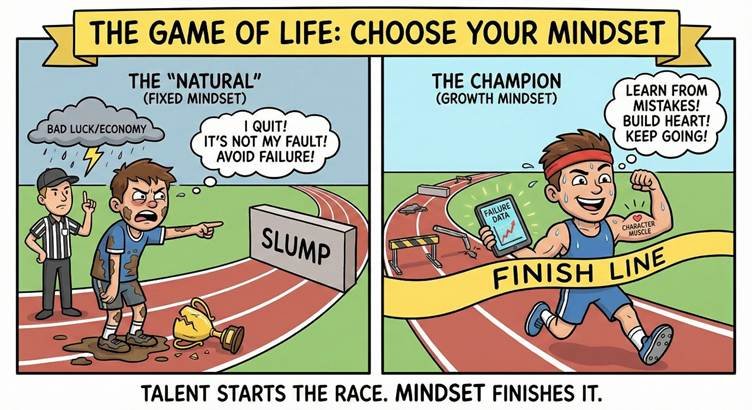
Whether you are an athlete, a business owner, or a student, you are playing a game. You can choose to play like a victim of The Curse of the Natural. You can rely on your old skills, avoid things you aren’t good at, and crumble when you hit a low point. You can blame the referee, the economy, or your boss when things go wrong. Or, you can play with a Champion’s Mindset.
You can admit that you aren’t perfect. You can look at your failures as data, not disasters. You can understand that “heart” and “character” are not things you are born with—they are muscles you build every time you choose to keep going when you want to quit. Talent might get you a head start. But mindset crosses the finish line.
Credit / References
Book Name: Mindset: The New Psychology of Success
Author Name: Carol S. Dweck, Ph.D.
Note: The stories regarding Billy Beane, Michael Lewis (Moneyball), Muhammad Ali, Michael Jordan, Babe Ruth, Wilma Rudolph, Jackie Joyner-Kersee, and John Wooden are derived from the research and narrative presented in Dr. Carol Dweck’s book.
Copyright Disclaimer
This article is written for educational and informational purposes only.
No copyright infringement is intended.
All original ideas and concepts belong to their respective author(s).
For any concerns or queries, please contact: contact@mohitsidana.com
FAQs
1. Is it true that “naturals” often fail later in life?
Yes, this is common and is often called The Curse of the Natural. Athletes or students who find early success without effort often develop a “Fixed Mindset.” They learn to link success with “not trying.” When they finally reach a level where effort is needed (like the pros or college), they often quit because they think working hard means they aren’t talented.
2. Can you teach “character” or mental toughness?
Absolutely. Character is not a fixed trait like eye color. It is a learned behavior. By consistently praising effort rather than talent, and by viewing setbacks as learning opportunities, coaches and parents can build resilience and “heart” in young athletes.
3. Why do some super-talented athletes seem to choke under pressure?
This often comes from the “Somebody-Nobody” feeling found in The Curse of the Natural. If an athlete believes that winning makes them a “Somebody” and losing makes them a “Nobody,” the stakes become too high. The pressure to prove their worth can be stopping, leading to failure in big moments.
4. How did Michael Jordan become so good if he was cut from his high school team?
He adopted a Growth Mindset. Instead of seeing the cut as proof he wasn’t good enough, he saw it as proof he needed to work harder. He developed a legendary work ethic, practicing in the early mornings and constantly refining his weak points, which eventually made him superior to players with more “natural” talent.
5. What is the best way to develop a Growth Mindset in sports?
Focus on the process, not the outcome. Instead of setting a goal to “win the game,” set a goal to “give 100% effort on every play.” Analyze your losses to find areas for improvement rather than making excuses. View your skills as things that can be built, not gifts you simply receive.
For Next Chapter of this book (Click here)